

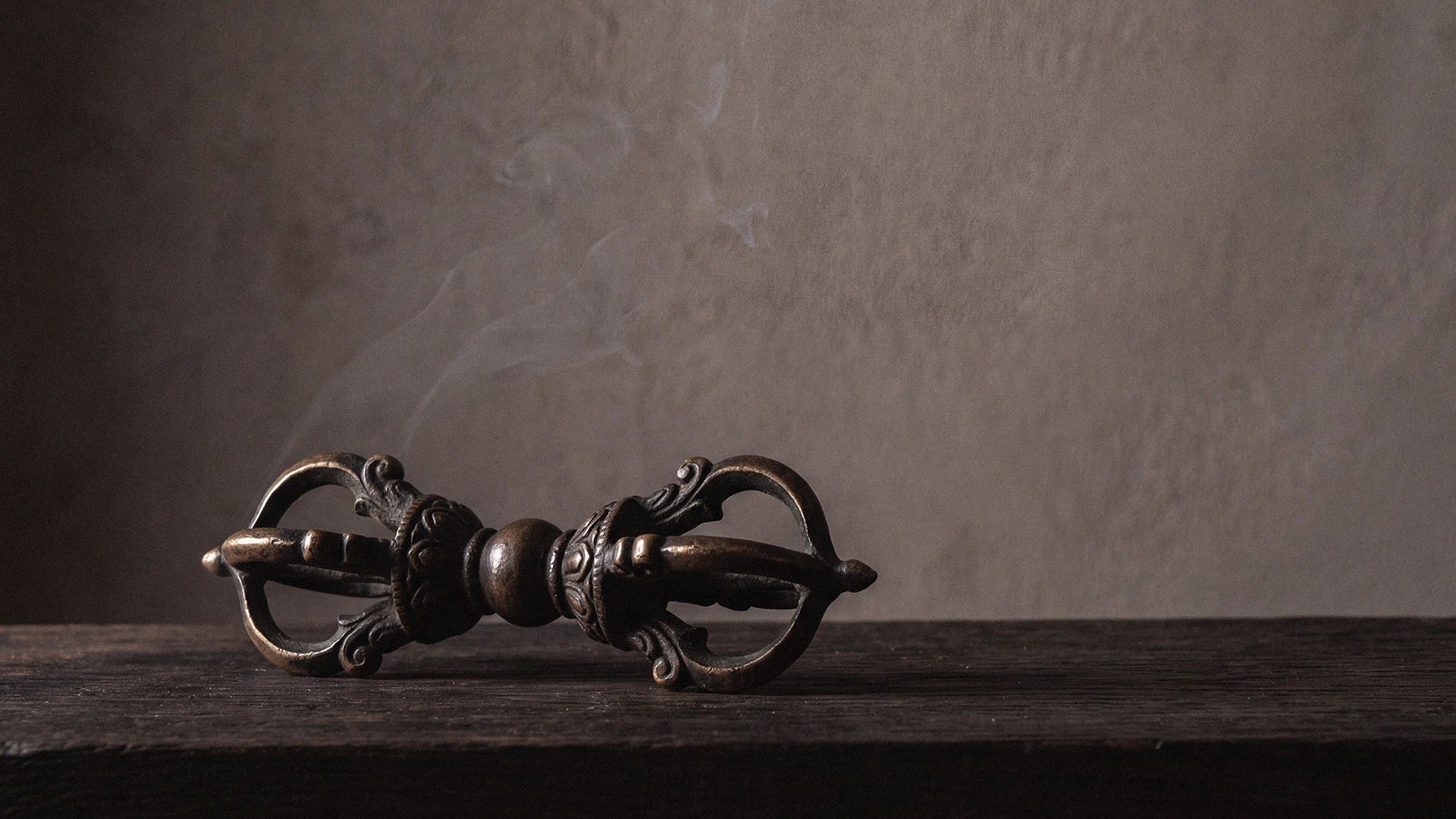
If you have spent any time among Tibetan Buddhist names, you have probably noticed one word returning again and again: Dorje. It shows up in a teacher's name, in the name of a meditational figure, in the title of a practice, and in the name of a ritual object held in the hand. One syllable, several jobs.
That repetition is not an accident. Dorje is a single Tibetan term that plays several distinct roles, and the clearest way to understand it is to separate those roles rather than fold them into one definition.
This article explains what the word means, how it works inside Tibetan personal names, which well-known figures carry it, how titles and practice terms use it, and how it is spelled and pronounced. Traditional meanings are described in attributed terms; the modern reading offered near the end belongs to Kailash to Shambhala, and is kept separate from the cultural layer rather than folded into it.
Key Takeaways
- Dorje is the Tibetan term most commonly matched to the Sanskrit vajra, conventionally rendered in English as "thunderbolt" or "diamond."
- It works as a word, as an element in personal names, and as part of figure names, titles, and practice terms.
- Tibetan personal names often draw on religious and auspicious vocabulary, and Dorje can appear first or second in a compound name.
- Figures and practices connected to the name belong to specific traditions; details of iconography, lineage, and practice vary by source.
What Does "Dorje" Mean?
Dorje is the Tibetan word most often matched to the Sanskrit term vajra. In English it is conventionally rendered in two ways — "thunderbolt" and "diamond" — and both point toward the same underlying idea: something indestructible, unbreakable, or unwavering.
The two renderings are not competing translations so much as two images for one thought. A diamond suggests hardness and clarity. A thunderbolt suggests sudden, unstoppable force. When the term is explained in Tibetan Buddhist contexts, the emphasis usually falls on the shared quality behind both images rather than on either picture alone.
Alongside that symbolic meaning, the word also names a physical ritual object — the double-ended implement held in the hand during certain practices. A single term therefore covers both a concept and a thing, which is one reason the word can feel ambiguous the first time a reader meets it.
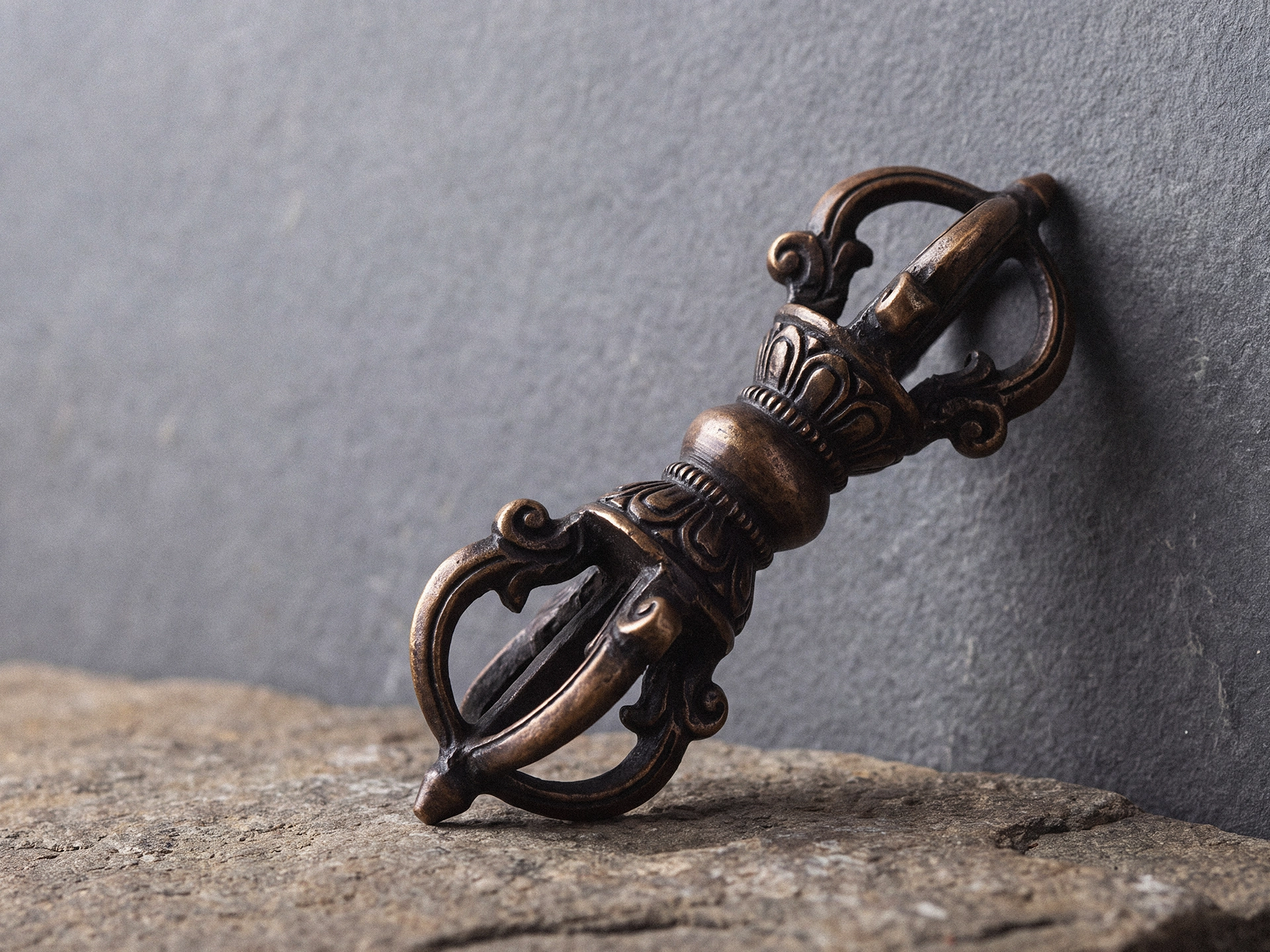
Before separating the naming and terminology roles, it helps to see where the two common forms of the word come from.
Sanskrit Vajra and Tibetan Dorje
The Sanskrit form is vajra. The Tibetan equivalent is dorje, and English writing uses whichever form suits the context in front of it.
In practice, "vajra" tends to appear in transliterated Sanskrit terminology — Vajrasattva, Vajrapani, vajra master. "Dorje" tends to appear in Tibetan-derived names and terms, including personal names and the names of figures and practices transmitted through Tibetan traditions. The two are not different concepts; they are two languages carrying the same word.
| Term | Language | Common English rendering |
|---|---|---|
| Dorje (rdo rje) | Tibetan | "thunderbolt" or "diamond" |
| Vajra | Sanskrit | "thunderbolt" or "diamond" |
One consequence is worth noting early: when you see "Vajra" in one English sentence and "Dorje" in another, you may be looking at the same idea twice. The choice of form usually reflects the source language of the term being discussed, not a difference in meaning.
Dorje as a Tibetan Name
Dorje is a common element in Tibetan personal names, and it is usually combined with other words rather than used on its own. It can appear first or second in a compound name.
Tibetan names are frequently drawn from religious and auspicious vocabulary, and Dorje belongs to that broad family of name elements. A reader who encounters several people, teachers, or authors named with Dorje is seeing a naming practice rather than a narrow set of coincidences.
Because the element is widespread across regions and generations, it is more useful to describe patterns at a general level than to publish a fixed catalog of individual names and their meanings. Specific names carry their own histories, and those histories are best confirmed with the people and communities who use them.
Why So Many Names Include Dorje
Devotional and auspicious words are common in Tibetan naming, and words with a strong symbolic charge appear again and again across families and generations.
There is no single rule that explains every name. Naming is a living practice shaped by family, region, teachers, and time. Treating it as a rigid system with one fixed reason per name would misrepresent how it actually works.
Major Figures Whose Names Include "Dorje"
Many well-known figures, teachers, and protector forms carry "Dorje," or its Sanskrit "Vajra," in their names. These figures belong to specific traditions, and details of iconography and practice vary by lineage and source.
The figures below are commonly encountered in English-language writing. Each is described in attributed terms rather than as a fixed, universal definition.
Dorje Sempa (Vajrasattva)
Dorje Sempa is the Tibetan name commonly given for Vajrasattva. The figure is widely associated with purification practice in Tibetan Buddhist traditions.
That association is the part most often cited when the name is introduced, and it is best stated as an attributed tradition rather than as a fixed definition that applies identically everywhere. Detailed ritual content belongs to the living traditions that transmit it.
Dorje Drolö (Dorje Drollo)
Dorje Drolö is a name traditionally associated with Padmasambhava, described as one of his manifestations. English spelling varies — Drolö, Drollo, Drolod — and the variants refer to the same name.
The variation is a reminder that Tibetan terms written in the Latin alphabet pass through more than one romanization convention. Different books and websites may spell the same figure in slightly different ways, and the difference is orthographic rather than substantive.
Dorje Phurba and Vajrakilaya
Dorje Phurba is the Tibetan name associated with Vajrakilaya. The name connects to the phurba, the ritual dagger that appears as a named ritual form in Himalayan and Tibetan Buddhist contexts.
At this level of description, the useful point is the relationship between a name and a ritual object: the name points toward a body of practice and iconography rather than toward a single dictionary definition.
Other Dorje-Named Figures and Forms
"Dorje" also appears in the names of teachers, protector forms, and practice terms that readers may come across in search results and book indexes — Dorje Gotrab among them.
These names point to specific contexts and traditions. Precise meanings are best confirmed through qualified lineage sources rather than assembled from general reference material, and this article does not assign a fixed meaning to a name where the available evidence is limited. Covering fewer names accurately is more useful than covering more of them loosely.
Vajra Names and Titles: Masters, Honorifics, and Address
In English writing, the Sanskrit form "vajra" often appears in transliterated titles and terms. A frequent source of confusion is that a personal name and a title can look similar in a sentence, even though they do quite different work.
Vajra Master
"Vajra master" (vajracharya) is a term used for a qualified tantric teacher. It describes a role and a qualification within a tradition rather than a personal name.
The specifics of how that qualification is understood vary across lineages, which is why the term is best described as a role rather than reduced to a checklist.
Rinpoche and Respectful Address
Rinpoche is an honorific title, commonly rendered "precious one," used as a respectful form of address. It is a title, not a personal name and not a fixed office.
Where the term tulku appears in connection with Tibetan Buddhist teachers, it refers to a recognized reincarnation lineage — a living tradition within some Tibetan Buddhist lineages. Describing it as a tradition is not the same as asserting the validity of any particular recognition, and this article stays with the general description.
Mantra and Empowerment: Understanding the Terminology
In Tibetan Buddhist contexts, "dorje" also appears inside practice terminology, including mantra names and empowerment terms. Recognizing the vocabulary is useful even for readers who never intend to practice.
A mantra is a recited phrase or syllable sequence used in practice. An empowerment, or initiation, is a transmission traditionally given by a qualified teacher within a lineage. Both terms describe parts of living traditions rather than free-standing information that can be assembled from an article.
Search terms such as dorje prayer, dorje gotrab mantra, dorje phurba mantra, and dorje gotrab empowerment point to specific practices. This article explains what the vocabulary refers to without reproducing recitation instructions, visualizations, or empowerment procedures; those traditionally come from a qualified teacher within an established lineage.
Vajra Name and Related Compounds
A "vajra name," in some contexts, refers to a name given within Vajrayana practice, often in connection with empowerment.
Compound terms such as vajra dakini also appear in Tibetan Buddhist writing, where they describe figures or aspects within a specific framework. These terms are best left at a broad, attributed level; a general article is not the right instrument for completing a taxonomy of them, and any attempt to do so would trade accuracy for neatness.
Spelling, Pronunciation, and Translation Questions
Dorje has several common English spellings, and pronunciation varies between Tibetan and English speakers. The conventional Tibetan spelling is rdo rje.
Romanizations in wide use include Dorje, Dorjé, and Dorjay. English speakers generally approximate the sound rather than reproduce Tibetan pronunciation exactly, and different contexts settle on different conventions — so variation is expected rather than a sign that something is wrong.
It is also worth separating a conventional English rendering from a literal translation. "Thunderbolt" and "diamond" are the standard renderings, not a word-for-word equivalent, and treating them as exact translations overstates what they are.
| Spelling | Context | Notes |
|---|---|---|
| rdo rje | Tibetan (Wylie transliteration) | Conventional written form of the Tibetan term |
| Dorje | General English | Most common in names and general writing |
| Dorjé | English with accent | Used to indicate the final vowel sound |
| Dorjay / Dorjey | English phonetic | Approximates pronunciation for English readers |
Dorje in Modern Ritual Life: A Kailash to Shambhala Interpretation
The cultural core of the term is the idea of the indestructible and the steadfast, expressed through the imagery of diamond and thunderbolt. That meaning stands on its own, and nothing in this section replaces it.
What a contemporary reading can do is carry that idea into a quieter register. A diamond's clarity, a thunderbolt's unbroken force — both translate naturally into the language of attention, boundary, and steadiness in ordinary life: the quality of staying with one thing, of holding a line, of returning to a settled center.
For Kailash to Shambhala, this is where the term meets modern ritual life. The brand reads Dorje symbolism as a quiet emblem of clarity, boundary, and inner order, and connects it to the idea of inner Shambhala — a settled inner state reached by return rather than by arrival.
That reading shows up most naturally in objects rather than arguments. A dorje form carries a recognizable silhouette: two ends, a central grip, prongs that separate cleanly in ordinary light, metal that darkens with handling over time. As a wearable piece or a small desk or altar object, it works less as a statement than as a point of return — something the hand finds without being asked to.
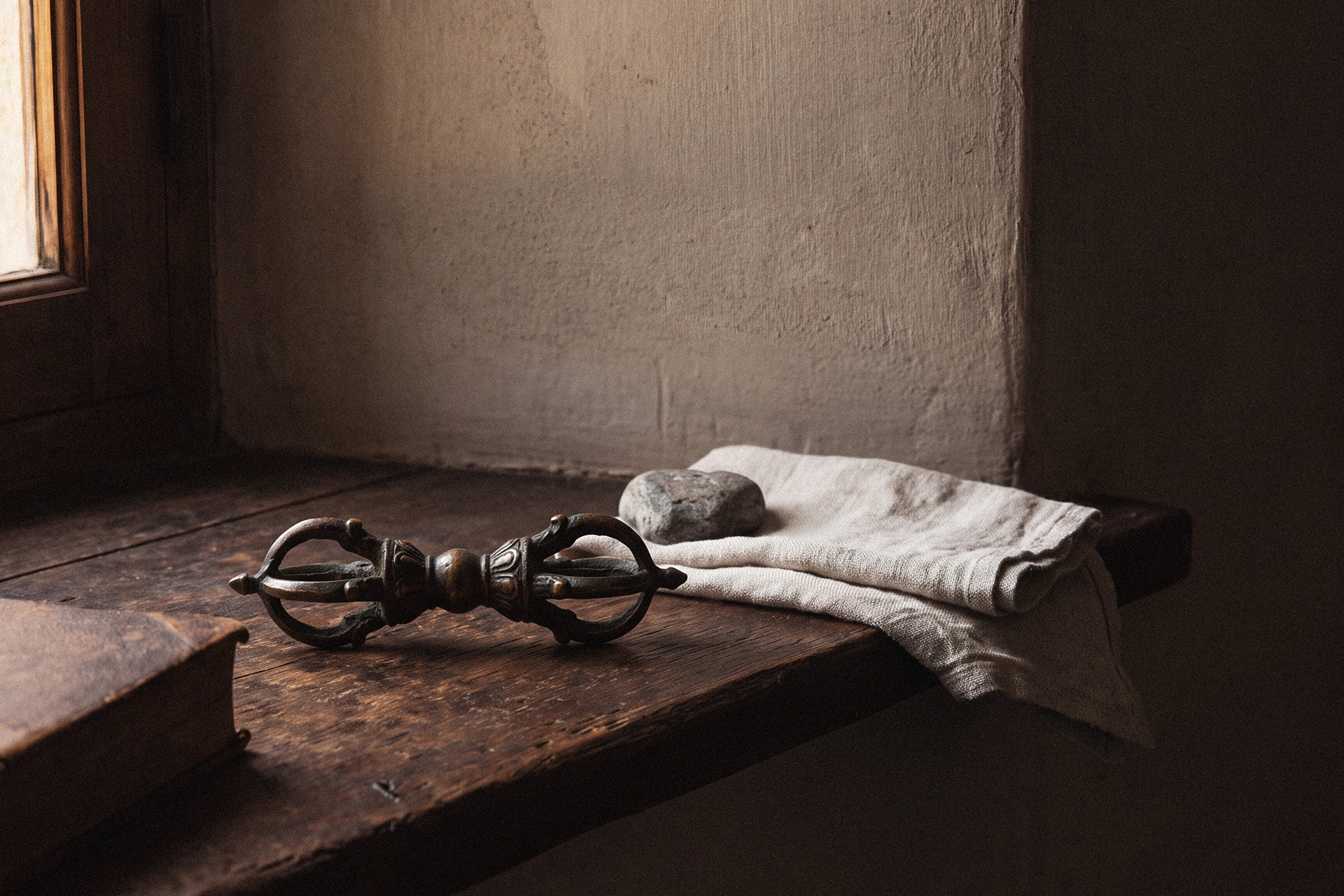
This is an additive layer. The tradition explains what the symbol means; the contemporary reading simply suggests a place for it in a modern room or a modern day. The object is not asked to guarantee anything, and the symbolism does not depend on it doing so.
Frequently Asked Questions
Who is Vajra — a person or a symbol?
Vajra is primarily a Sanskrit term and a ritual object rather than a single historical person, though it appears in the names of several figures. The same name element does different work in each case: one word serving as a concept, an object, and a set of figure names.
Is Dorje a male name, female name, or both?
Dorje functions as a name element rather than a strictly gendered given name. Because it is usually combined with other words, any sense of gender tends to come from the compound rather than from Dorje itself, and usage varies across families and regions.
Do you need an empowerment to use a dorje mantra?
In Vajrayana, many practices are traditionally received through empowerment from a qualified teacher. Specific requirements vary by lineage and tradition, and this article explains the vocabulary of mantra and empowerment rather than offering practice instructions.
Conclusion
Dorje is one term with several roles. It is a word matched to the Sanskrit vajra and rendered in English as "thunderbolt" or "diamond." It is an element in Tibetan personal names. It appears in the names of figures such as Dorje Sempa and Dorje Drolö, in titles such as vajra master, and in practice terms around mantra and empowerment.
The thread that holds those roles together is the idea the term carries — the indestructible, the unbroken, the steadfast. Everything else is that idea applied in a particular setting: a name, a figure, a title, a practice.
The figures and practices connected to the name are best understood inside their own traditions, where their details are transmitted rather than summarized. Read quietly, though, the same symbolism also lends itself to modern ritual life — and through Kailash to Shambhala, it can sit on a desk or at an altar as a modest emblem of clarity and steadiness, an object of return rather than a promise.