

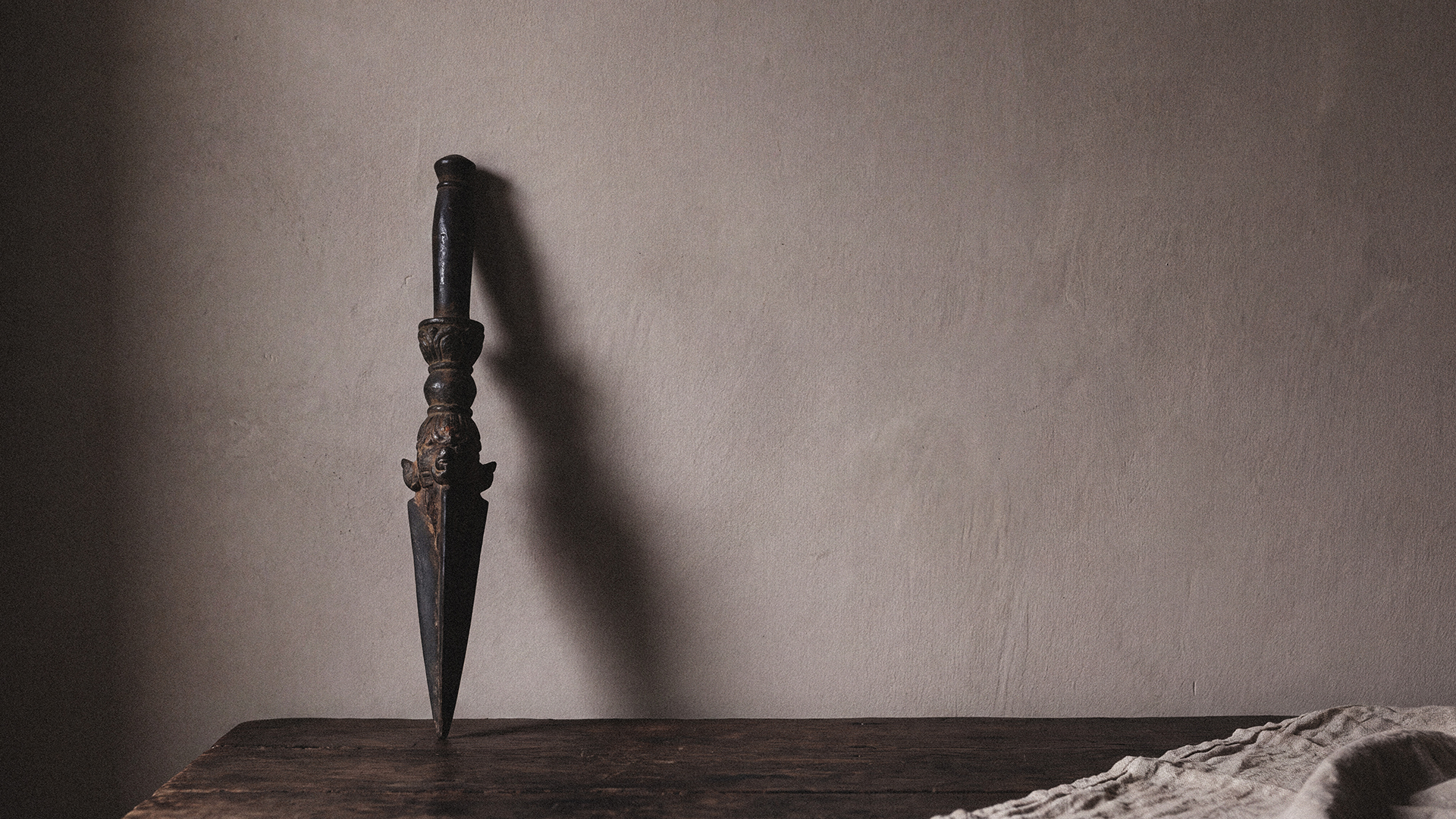
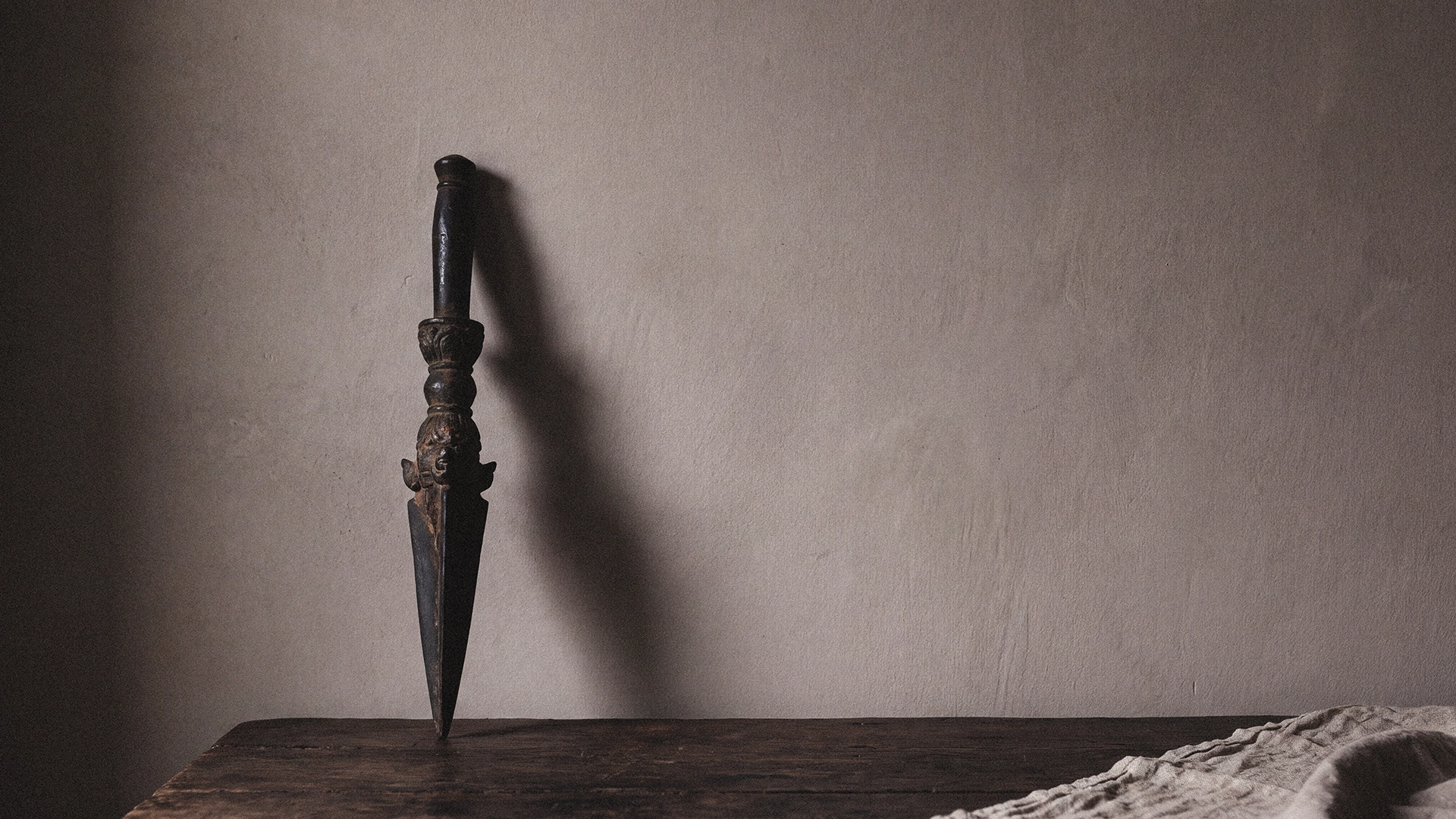
A phurba is a ritual implement in Tibetan Buddhist practice, usually described in English as dagger-shaped or spike-shaped. Most readers meet it the same way: behind museum glass, on a market table, on a home shrine, or in an online listing that explains very little about it. The form is striking, and the descriptions that travel with it are often contradictory.
What resolves the confusion is a shift in emphasis. The phurba is a ritual implement first and an object of interest second, and its meaning is not separable from the role it plays in practice. That relationship between what an object is and what it does inside a tradition is also what makes the subject matter to Kailash to Shambhala, whose approach to Himalayan-inspired objects begins with context rather than appearance.
This article covers what a phurba is, what the names around it refer to, how it functions in Tibetan Buddhist ritual, what its form and materials express, and how phurba-form objects appear today in Western homes. It describes the implement in broad, well-attested terms. It does not offer ritual instruction; detailed practice is transmitted within living traditions and under qualified guidance.
In brief: a phurba is a ritual implement most closely associated with the Vajrakilaya cycle of practice. Its symbolism is bound up with stabilizing, defining, and holding a boundary. The phurba-form objects now kept in Western homes are best understood with that original context in view.
What Is a Phurba?
A phurba is a ritual implement from Tibetan Buddhist practice, commonly described in English as dagger-shaped or spike-shaped. The resemblance is visual. The object shares a silhouette with a blade, but it belongs to ritual rather than to practical cutting or piercing.
The recognizable form is consistent enough to identify at a glance. A blade tapers to a point, a handle sits above it, and the section between blade and handle is often carved or modelled — this is where much of the visual variation appears. Beyond that, phurbas range widely: small hand-scale pieces and larger, heavily ornamented examples, spare and plain forms alongside densely detailed ones. Size, proportion, and finish are not standardized, and a description of one example will not fit all of them.
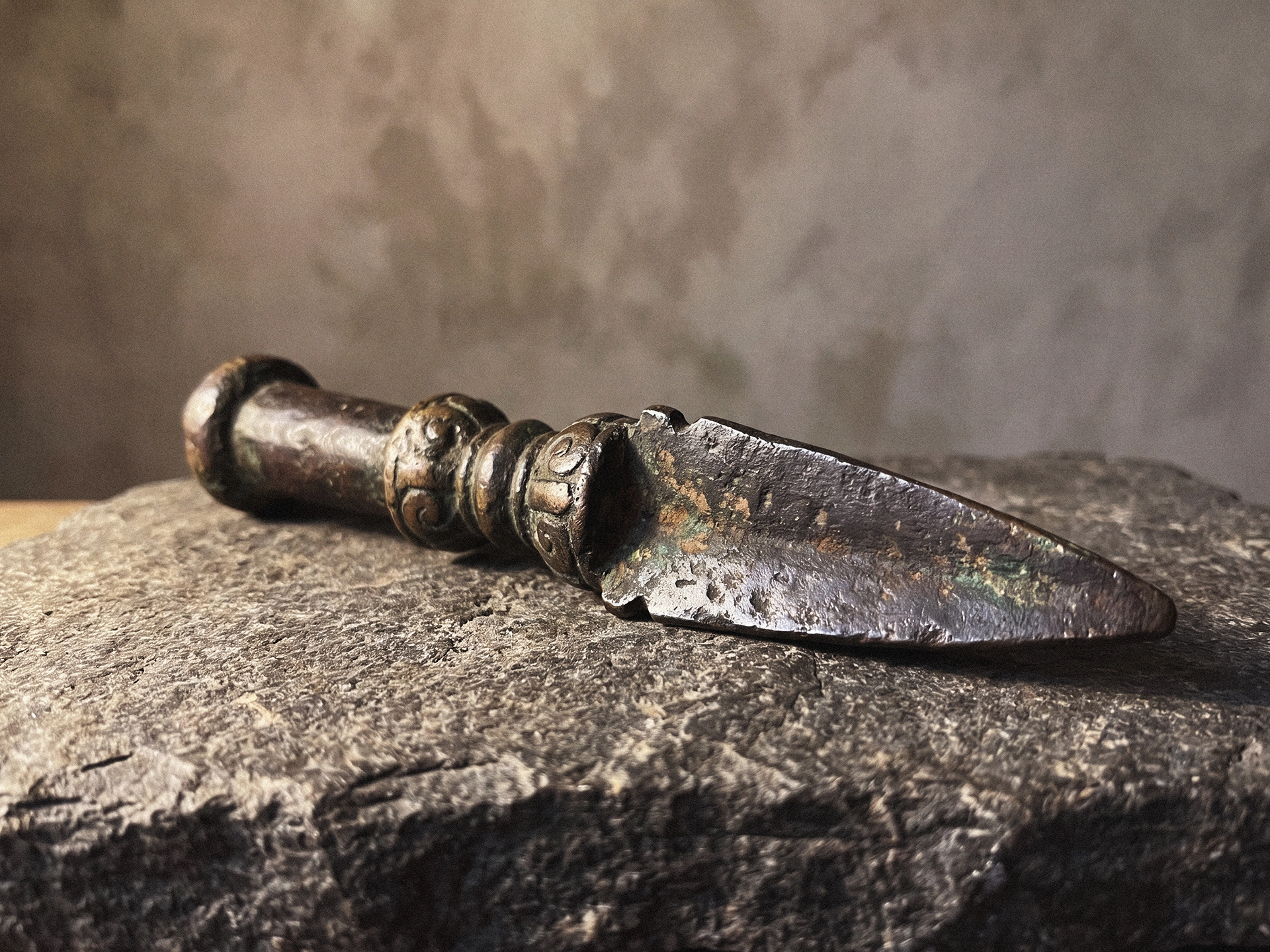
English sources reach for "dagger," "knife," and "spike" because those words describe the shape quickly. They also mislead a little. "Knife" suggests an everyday cutting tool, and "tool" suggests a general-purpose instrument pressed into ritual service. Neither matches the object's actual role.
Part of the reason online descriptions differ so much is that the phurba is encountered both inside practice and far outside it. Museum catalogues, antique dealers, practitioners, and interior-focused buyers all write about the same form from completely different positions, and each produces a different kind of text.
Phurba, Kila, and Dorje Phurba: What the Names Refer To
The same implement is known in English by a Tibetan-derived name and in Sanskrit-language sources by a different one, and a compound form appears in practice contexts. These are names for one object, not for three.
General sources often gloss the Sanskrit term as "peg" or "nail," which points back to the implement's defining imagery rather than to a hardware function. "Phurba" is the form most common in English and the one used throughout this article. "Kila" appears chiefly in Sanskrit-language and academic writing, where the same object is under discussion. "Dorje phurba" is a compound that brings together the Tibetan term for the vajra and the term for the phurba, and it belongs to terminology rather than to a separate category of object.
The term travels across Himalayan regions, and usage varies locally. Where a region-specific meaning cannot be supported, it is better left out than guessed at.
| Term | Language / Source | How It Is Used in English |
|---|---|---|
| Phurba | Tibetan-derived term, most common in English | The standard English name for the implement |
| Kila | Sanskrit-language sources | Refers to the same implement; often glossed as "peg" or "nail" |
| Dorje phurba | Compound used in practice contexts | Names the implement together with the vajra (dorje) in a specific practice setting |
Phurba and Dorje: Two Different Objects
The vajra, known in Tibetan as the dorje, and the phurba are distinct implements that can nonetheless appear together in the same practice context. The dorje is short, symmetrical, and double-ended, with a matching form at either end. The phurba is a single tapered blade held by a handle. Seen side by side, they are not alike.
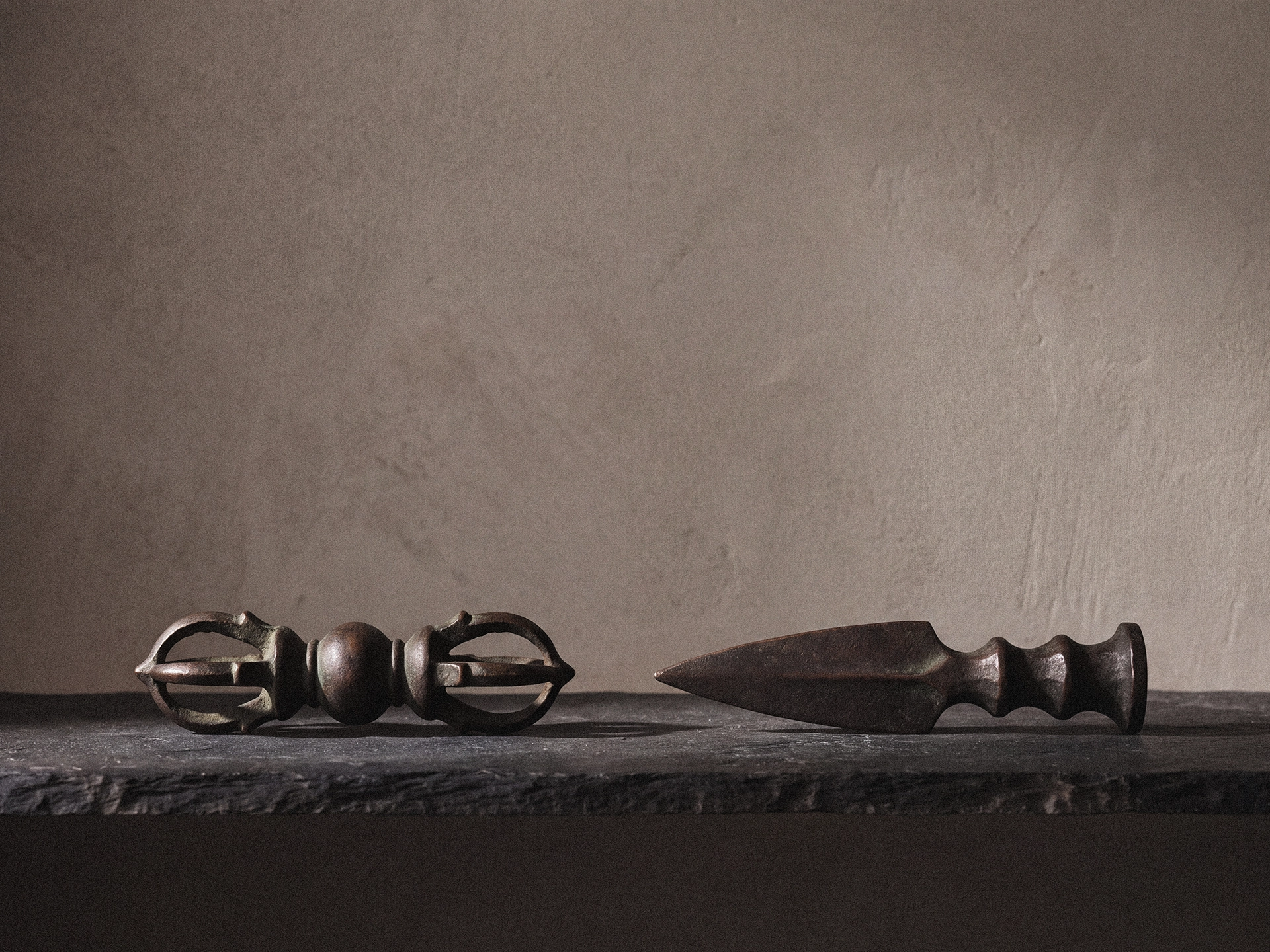
The confusion is mostly a matter of naming. Compound terms such as "dorje phurba" place the two words next to each other, and readers reasonably assume they describe one thing. They do not.
The Phurba's Role in Tibetan Buddhist Ritual
Within Tibetan Buddhist practice the phurba functions as a ritual implement. It is not a weapon, and it is not a general-purpose tool.
Its role is broad. It is used within ritual and meditative practice, and it is most closely associated with one particular cycle of practice while still appearing in other ritual contexts. Practices involving the phurba are traditionally transmitted within specific lineages, under the guidance of qualified teachers — which is precisely why the object's role can be described without describing its use. Held in the hand, used as part of a structured ritual procedure: for a general account, that is as far as it should go.
Different Himalayan Buddhist contexts describe the implement's role in their own terms, so broad language here is deliberate rather than vague.
Phurba and Vajrakilaya
Vajrakilaya is the tantric practice most closely associated with the phurba in Tibetan Buddhist tradition. The implement and the practice are understood and named together, which is why English sources so often place "phurba" and "Vajrakilaya" in the same sentence, and why the compound "dorje phurba" turns up in this context.
Recitation forms part of the practice. The wording belongs to the lineage that carries it and is not reproduced here; the same is true of visualization sequences and lineage-specific procedure. Those elements are transmitted directly, by teachers, within a living tradition — not through an article about an object.
How Is a Phurba Used?
The question usually means one of two things, and they have different answers.
If it is a general question about function, the answer is straightforward: in practice the phurba is held in the hand and used within a structured ritual procedure, and its role belongs to practices traditionally transmitted by qualified teachers within specific lineages.
If it is a request for instructions, that is where a general article has to stop. The specific sequence, hand positions, and recitation are learned from a teacher within a lineage, not from a description. What a reader outside those traditions can properly learn is what the object is, what it expresses, and why it is treated with care.
Phurba Symbolism: What the Form Expresses
The phurba's symbolism is bound up with its function. It is not an ornament that carries meaning separately from what it does in practice, and reading it purely as decorative geometry misses the point.
The central image is that of a peg driven into the ground: pinning down, stabilizing, holding something in place so that it does not shift. The blade, the point, and the handle each carry symbolic weight in general descriptions of the object, but sources vary in how they describe individual elements, and no single explanation should be presented as the authoritative one.
What holds across descriptions is the underlying idea — a form that defines and holds what it is placed upon, rather than one that cuts loose from it.
Protection, Boundary, and Sacred Space
Protective association is a central part of how the implement is understood within its tradition. In broad terms, the ritual idea is one of establishing and holding a boundary: guarding, steadying, and marking out a defined space.
This connects to a wider pattern in Himalayan practice, where sacred space is deliberately defined rather than assumed — corners, thresholds, and directions are marked, and the boundary is understood as something made and maintained. The phurba belongs to that vocabulary of definition and holding.
The association is cultural and ritual. It belongs to the tradition's own language of boundary, stability, and guarded space, and it is described here in those terms.
Materials, Form, and the Marks of Time
General and museum-oriented sources most often describe phurbas in iron, in copper alloys such as brass or bronze, and in wood for some examples. Ornament on the mid-section may be cast, carved, or worked in a combination of materials.
Structurally, the object reads in three parts: blade, mid-section, handle. Those proportions are what make a phurba identifiable even when detail is lost or worn.
Size, weight, and finish vary widely. Plain examples exist alongside highly detailed ones, and a small hand-scale piece may carry the same essential form as a large ornamented example.
Surface wear is often the most informative thing about an older piece. A much-handled handle takes on a soft polish; oxidized metal darkens and settles into recessed carving; edges lose their sharpness. These are traces of handling and of time passing over an object — evidence of use rather than damage. Nothing in that surface tells you a specific date or origin with confidence, and readers are better served by looking at wear as a record of contact than as a certificate of age.
The short material study below follows a phurba-form object standing upright on a dark surface, moving from the tapering blade to the carved mid-section and worn handle as light shifts across the metal.
Seen in motion, the patina, softened edges, and depth of the carved sections register less as damage than as a record of handling and time.
Phurbas in Modern Life: Decorative and Contemplative Use
The phurba is now encountered far more often outside ritual settings than inside them — in shops, private collections, and homes, where it is usually kept for its form rather than its function. Many of the phurba-form objects offered in the West today are made and sold as decorative or contemplative pieces.
In a modern interior, the form reads clearly. A dark metal spike, a carved handle, a small upright presence: on a shelf or a desk, the object holds a vertical line that most decorative pieces do not. It sits well on a study desk, on a bookshelf, on a low shelf near a meditation cushion, or in a display case where the mid-section detail can be seen.
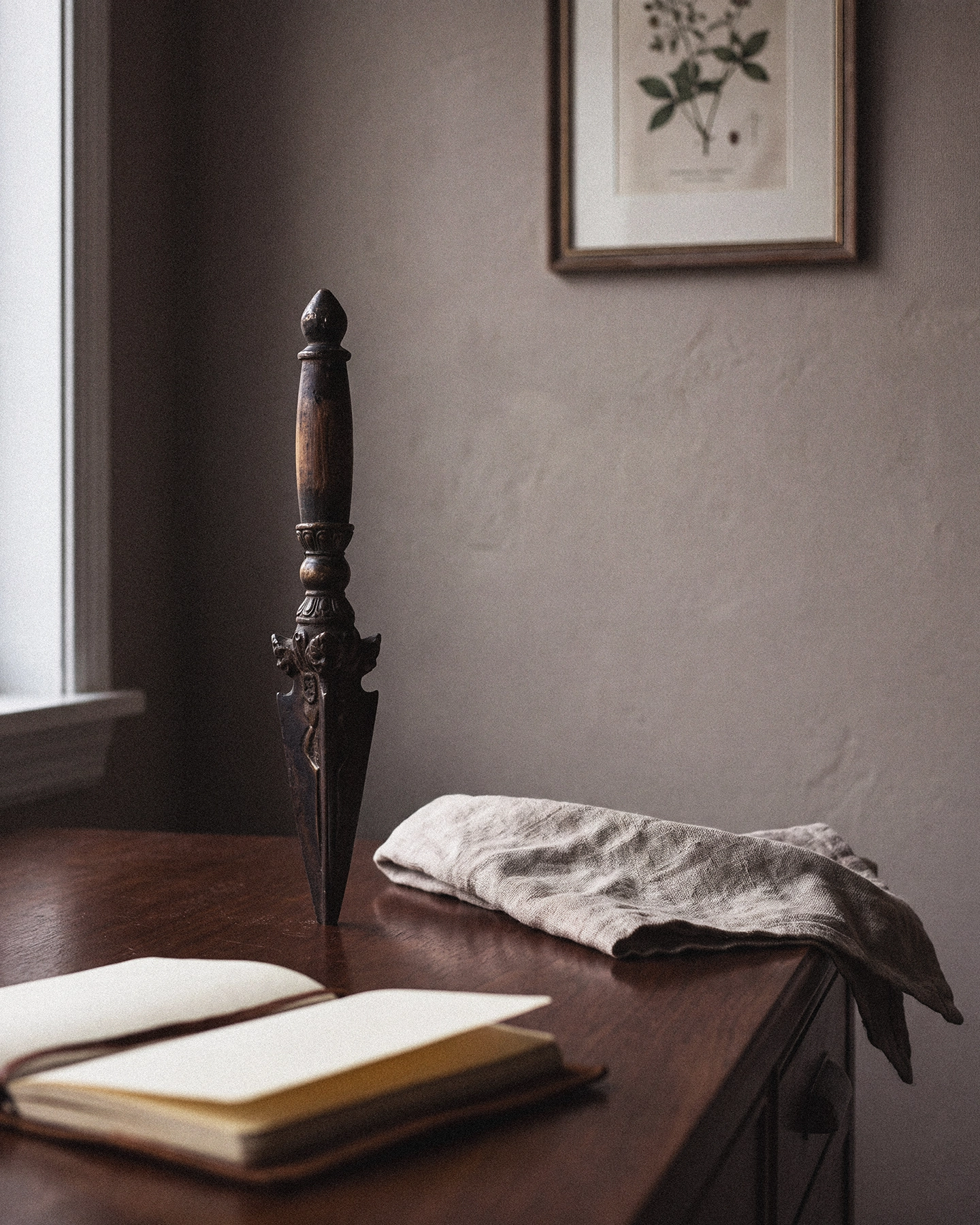
There is a practical distinction worth keeping in mind. Keeping a phurba-form object as a decorative or contemplative piece is one thing; treating it as a ritual implement is another, and the second belongs to the tradition that carries the practice. The distinction is not about authenticity, and it is not a judgment of quality. It is about context, and knowing which one applies is what allows the object to be held well.
For Kailash to Shambhala, forms like this one are interesting precisely because they carry that weight. An object with a defined role in a tradition gathers meaning through attention and repeated return — a hand resting on a carved handle, a glance across a desk, a place that is always the same. Understanding what the object is in its own tradition deepens that relationship rather than decorating over it.
Approaching a Ritual Form with Care
The same visual form carries different weight depending on where it sits and how it is treated. The practical response is simple: know what the object is, and let that knowledge guide the placement.
In ordinary language, that means a stable surface rather than a precarious one, a position out of casual reach, and handling that treats the piece as a deliberate object rather than an everyday tool. None of this requires ceremony. It is closer to the care given to any object that carries a history and a meaning beyond its materials.
Frequently Asked Questions
Is a phurba a weapon?
No. A phurba is a ritual implement. Its dagger-like appearance reflects its ritual form rather than a function as a weapon, and combat or self-defense has no part in the object's purpose. The visual resemblance is the main reason the question comes up so often, and it is a resemblance only — the blade form follows the ritual imagery of a peg driven into the ground, not the design of an arm.
How do you pronounce phurba?
The term is normally written in English in its Tibetan-derived form, and it also appears as two words in some transliterations. Pronunciation varies among speakers, regions, and traditions, and letters carried over from Tibetan do not map neatly onto English sounds. Most English-language sources treat "phurba" as the standard written form; beyond that, variation is normal, and a single settled pronunciation is not something a general article can prescribe.
What does "dorje phurba" mean?
The compound brings together the Tibetan term for the vajra (dorje) and the term for the phurba. It names the implement in a context where the two are understood together, rather than describing a separate object.
Can a phurba be kept in a home?
Yes. Many people keep phurba-form objects as decorative or contemplative pieces, and the form suits a shelf, a desk, or a display case well. The main consideration is understanding what the object is in its own tradition, so that its presence in a home is deliberate rather than accidental.
Conclusion
The phurba is best understood through its function. It is a ritual implement whose blade, mid-section, and handle all point back to a defined role within Tibetan Buddhist practice, and whose symbolism — the peg driven into the ground, the boundary established and held — is not separable from that role.
The naming history belongs to that picture too. Phurba, kila, and dorje phurba describe one object seen from different directions, and untangling them removes most of the confusion that surrounds it. So does placing the implement correctly against the dorje, a different object that shares a practice context and a compound name.
For a reader living far from those traditions, the object can still be held with understanding. A phurba-form piece on a desk or a shelf is a considered material presence — a vertical line, a carved handle, a surface that shows its handling. What it gathers over time comes from attention, material time, and return: the slow accumulation of meaning that belongs to any object a person chooses to keep.