

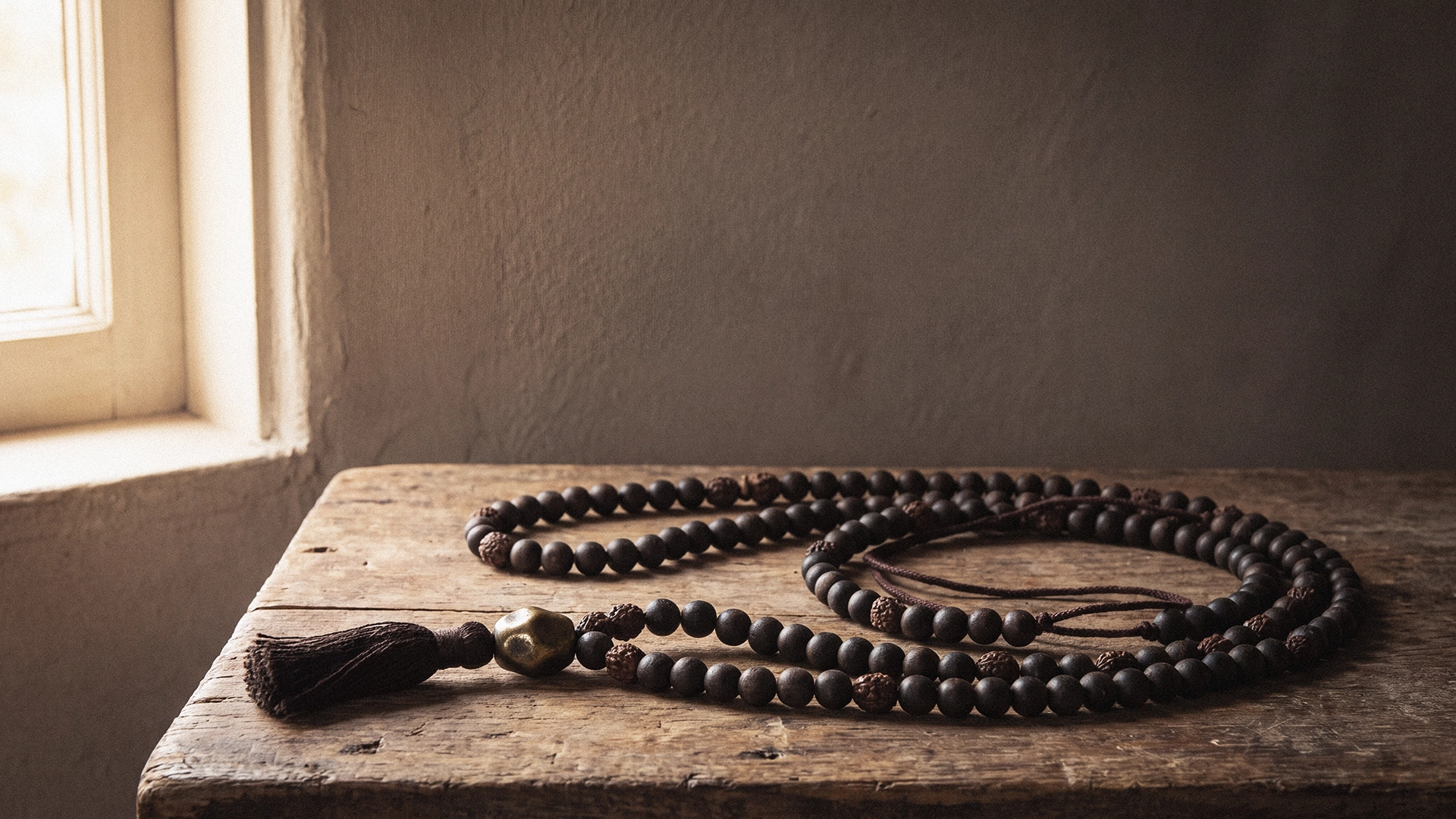
A mala rarely looks accidental. The beads are counted, the number is precise, and near the head of the strand there is usually one bead that sits apart, larger or differently shaped than the rest. Most readers who arrive at this question want to know one thing: is 108 simply how many beads fit on a cord, or does the number carry meaning of its own?
The short answer: 108 is the most common traditional count for a mala, understood as a complete and auspicious round. Smaller malas use 54, 27, or 21 beads, most often as fractions of 108 or as short strings made for daily wear. This is the kind of symbolism Kailash to Shambhala works with — Himalayan-inspired ritual forms whose meaning sits as much in how they are held and counted as in how they look.
What follows is the definition of a mala, why 108 became the standard, how the round is actually counted (including the guru bead that makes a 108-bead mala total 109), and how to read bead count when choosing one.
What Is a Mala?
A mala is a string of beads used to keep count during recitation or mantra practice. Its other common name, japa mala, comes from japa — the practice of repeating a mantra or a name in a steady rhythm. The strand is not a necklace in the ordinary sense, though it is often worn as one. Its first job is to hold a count so the person using it does not have to hold that count in their head.
Malas are shared across several traditions rather than belonging to just one, which is why their meanings are layered instead of uniform. A string of prayer beads of this kind appears in Hindu, Buddhist, Jain, and Sikh practice, and in Tibetan Buddhist contexts in particular it is a familiar working tool rather than a decorative object. The same form carries slightly different emphasis wherever it is used, so it is more accurate to speak of traditional associations than of a single fixed meaning.
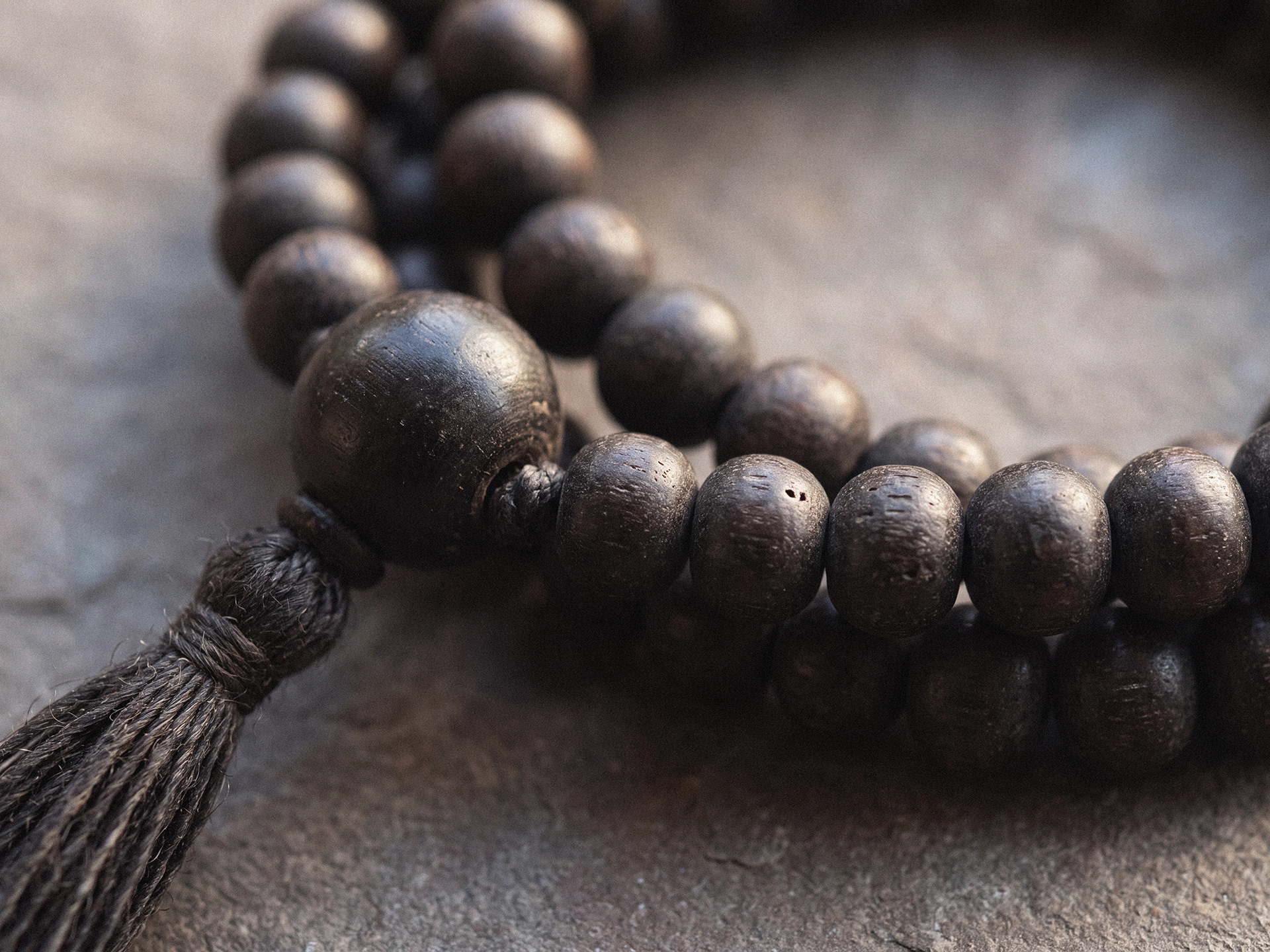
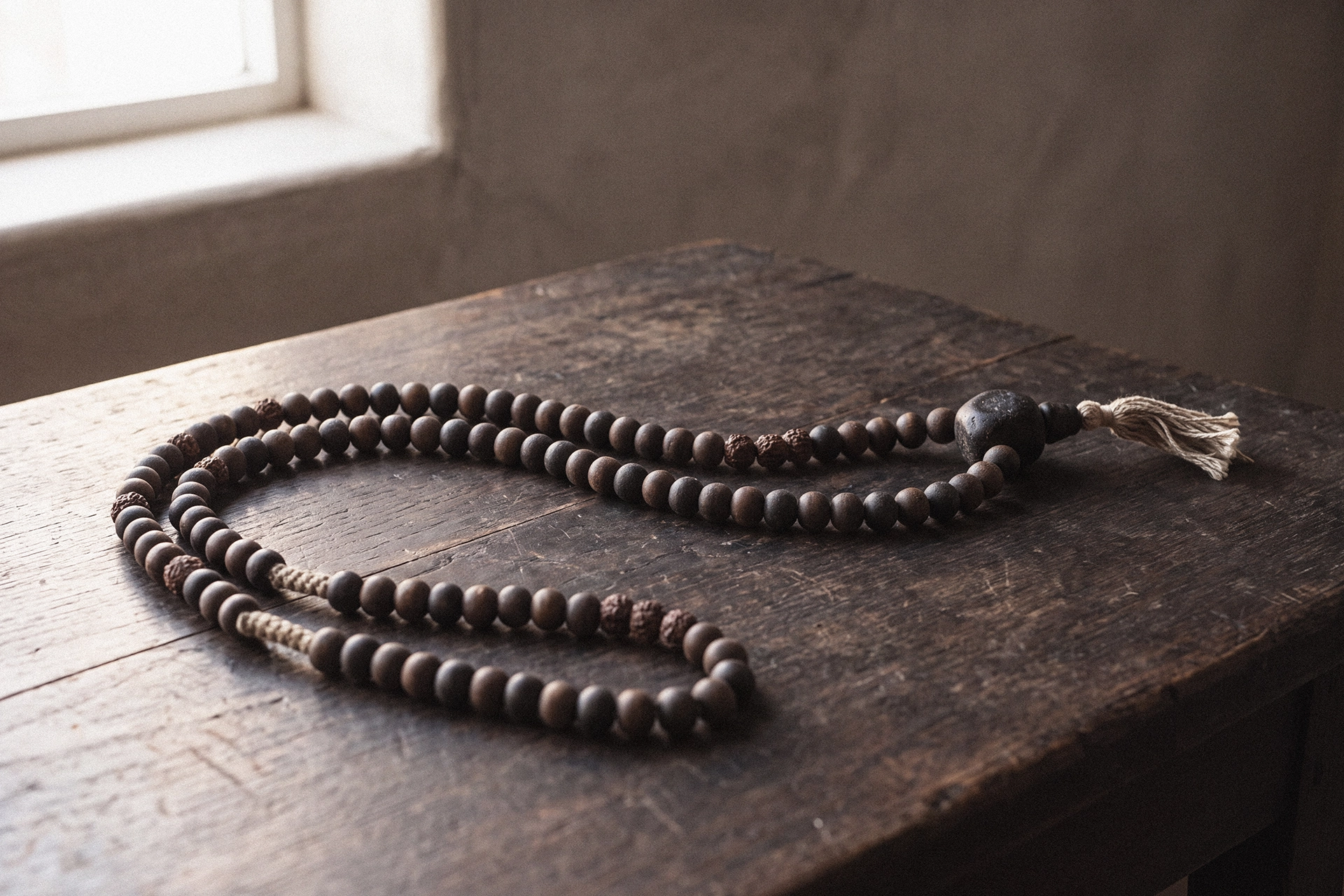
Physically, a mala is simple. Round beads — traditionally wood, seed, or stone — are strung closely on a cord, with a tassel usually finishing the strand. At the head sits a single bead that does not match the counting beads: the guru bead. Held in the hand, the beads move through the fingers in an even rhythm. Worn on the wrist or over the head, the strand carries a weight that a thin bracelet does not have.
Why the Count Matters
The number is a practical device before it is anything else. Counting recitations on the fingers fails quickly at any serious number; a strand of beads solves that problem by moving the count into the object. The practitioner recites once, moves one bead, recites again. Attention stays on the recitation rather than on the tally.
The same number is also read symbolically, and that reading is what the rest of this article explores. In traditional use the count and the round are not separate ideas: the number tells you how long the practice is, and the shape of the strand tells you that it is a closed loop.
Why 108 Beads on a Mala?
108 is the standard count because tradition treats it as a whole, complete, and auspicious number rather than an arbitrary quantity. It is the count most commonly used for a full mala across Hindu and Buddhist practice, and it is the number behind the everyday meaning of the term japa mala.
No single agreed origin explains it. What follows are the explanations most often given in traditional and devotional sources, grouped by theme, and understood as circulated readings rather than one verified fact.
Commonly Cited Traditional Explanations
Completeness and auspiciousness. The most consistent theme is that 108 is understood as a number that is finished, full, and whole — the kind of number used where a practice or a list is meant to be complete. This reading does not depend on any single cosmology. It treats the count as a full measure rather than a convenient length.
The number's wider cultural use. 108 recurs across South Asian religious and cultural life well beyond the mala. It appears in traditional lists of 108 names, in the traditional reckoning of 108 Upanishads, and in ritual counts and temple architecture. A number with that much presence in devotional culture came naturally to the prayer strand.
The return of the round. Because the beads form a loop, 108 recitations bring the practitioner back to the point where they began. Many traditional descriptions emphasize the closed circle of the round rather than the arithmetic of the number.
108 in Buddhist explanation. In Buddhist teaching contexts, the number is commonly linked to the 108 afflictions or defilements said to be worked through in practice — a framing that treats the count as a mirror of what the practice addresses rather than a measure of time. Different traditions emphasize different associations, and none of these readings cancels the others.
How 108 Works in Practice: Counting, the Guru Bead, and the Round
Usage is straightforward and has been for centuries. The practitioner sits, walks, or stands; takes the mala in one hand; and begins at the bead next to the guru bead. Each recitation is paired with one bead. When the round reaches the guru bead again, the 108 recitations are complete.
The guru bead — sometimes called the meru bead — is the head of the strand. It sits above the counting beads, marks the opening and closing point of the round, and is not counted among the 108. That single detail explains the counting confusion many readers run into: a mala described as having 108 beads holds 108 counting beads plus one guru bead, for 109 beads in total.
Conventions around the guru bead vary. In many traditions the round simply begins and ends there, and the practitioner turns the strand and continues rather than passing over the head bead. Other traditions treat the guru bead as a point of pause and a place to hold attention for a moment before the next round. Both are general usages rather than a single mandated procedure, and specific lineages keep their own instructions.
Why Are There 109 Beads on a Mala? And What About 110?
A mala with 109 beads is a 108-bead mala with its guru bead counted in. The 108 are the counting beads; the 109th is the head bead. This is the ordinary structure of a full mala, not a variant.
Totals above 109 usually come from the same logic extending further. Some malas carry small marker beads placed at intervals — often at the quarter points of the round — to help a practitioner keep their place without counting silently. Others include a spacer beside the guru bead, or a knotted divider before the tassel. None of these carry a separate traditional meaning as a number; they are structural. So a strand that appears to hold 110 beads is almost always 108 counting beads plus a guru bead plus one marker or spacer, rather than a distinct count with its own symbolism.
The cleanest way to read any mala is to look for the guru bead and count only the beads around it.
Other Common Mala Counts: 54, 27, and 21
108 is standard, but it is not the only valid count. A mala can be made at any length that serves the person using it, and several shorter counts are well established.
| Count | Relationship to 108 | Common use |
|---|---|---|
| 108 | Full round | Full-length practice; worn as a necklace or kept on an altar |
| 54 | Half of 108 | Shorter seated practice; a lighter strand for smaller frames |
| 27 | Quarter of 108 | Wrist mala; brief daily practice; travel |
| 21 | Not a fraction; a short count | Small wrist mala; short recitation practice |
54-Bead Mala Meaning
A 54-bead mala is half of 108, and it is usually chosen for exactly that reason: one full round covers half the count, and two rounds cover the whole. It is a practical size for anyone who finds a 108-bead strand too long or too heavy for seated practice.
27-Bead Mala Meaning
A 27-bead mala is a quarter of 108. Its relationship to the full count is direct and easy to track — four rounds complete the equivalent of a full mala — and its length makes it a comfortable wrist size for many people. It is one of the most common counts for a mala worn daily.
21-Bead Mala Bracelet Meaning
21 is not a fraction of 108; it is a short count chosen for wearability and for brief practice. Wrist malas in the 18 to 27 bead range are the norm, and 21 sits comfortably in the middle: small enough to be worn all day, long enough to hold a short recitation without constant turning. In some traditions, short practices are structured around 21 repetitions, which makes a 21-bead strand a natural companion to them.
Why Wrist Malas Often Use 21 or 27 Beads
A wrist mala trades length for wearability. Fewer beads mean less weight on the wrist, less cord to catch on clothing, and a strand that can stay on through a working day. A full 108 suits longer, seated practice at home, where the strand can rest in the hand or lie across the knee without being carried around. Neither is more correct than the other; they answer different needs.
How to Use Mala Beads: Holding, Counting, and Meditating
There is no single required technique, but the general shape of the practice is consistent.
- Take the mala in one hand and find the guru bead. The first counting bead is the one next to it.
- Recite your chosen phrase, mantra, or name once, then move one bead.
- Continue at a steady rhythm until you return to the guru bead. The round is complete.
- Pause, or turn the strand and begin again.
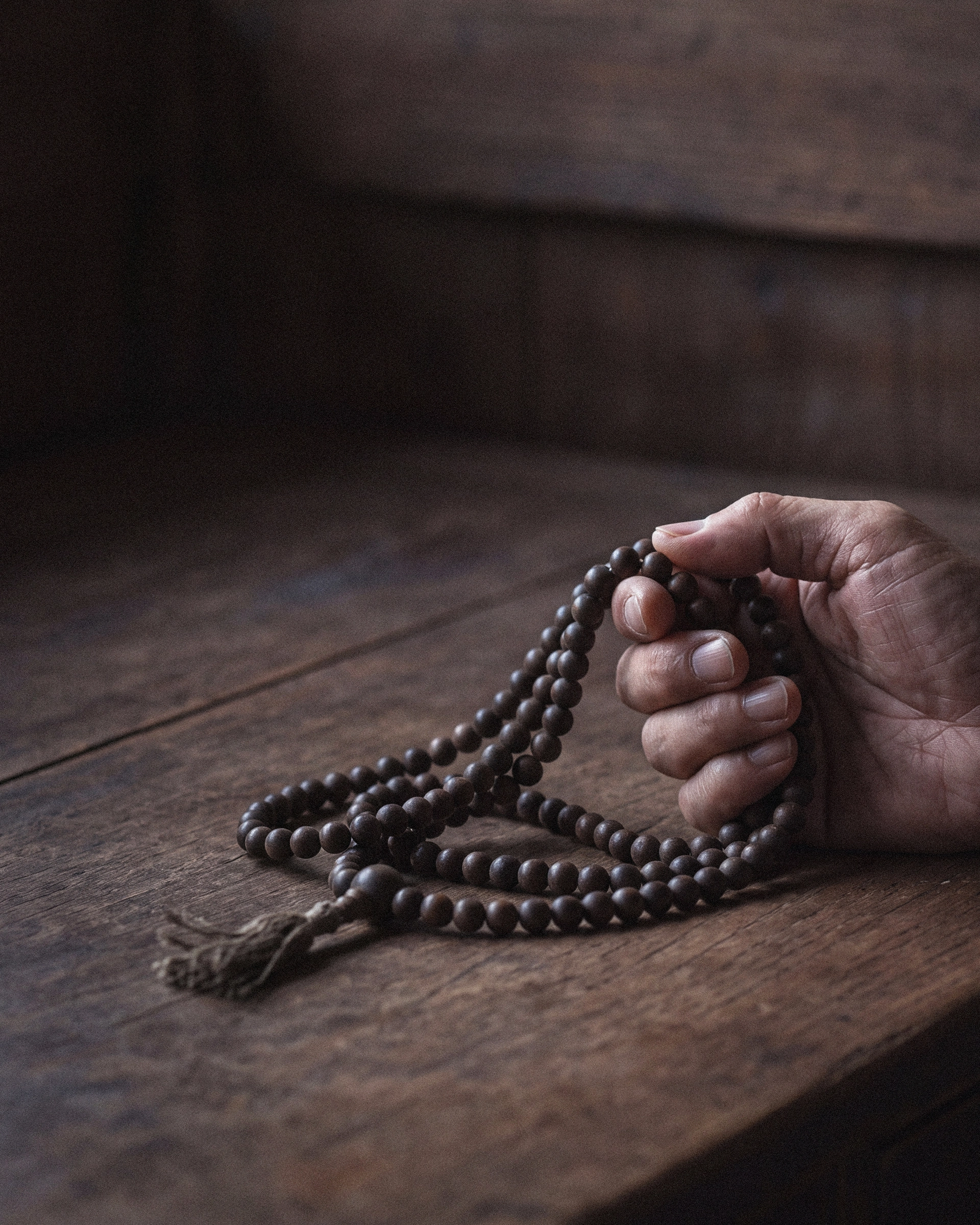
A common convention is to draw each bead toward you with the thumb while the strand rests on the middle finger, so the gesture stays the same bead after bead. Others simply roll the beads between thumb and fingers. What matters is that the motion becomes regular enough to stop requiring thought.
The recitation itself can be a mantra, a repeated name, or a short line of text. The mala holds the count; the recitation holds the attention. Pairing each recitation with one breath is a common way to settle into rhythm.
How you wear mala beads depends on the strand. Wrist malas are made to be worn as bracelets, where the beads sit against the pulse point and are touched without thinking. A full 108 is usually worn over the head as a longer strand, or kept in a pocket, a pouch, or on an altar between sessions. Some traditions keep a mala used for formal practice separate from a mala worn as jewelry; others do not, and the choice is generally personal.
Reading Bead Count When Choosing a Mala
Bead count is one of the clearest signals of how a mala is meant to be used. A full-length 108 suits seated practice at home, or wearing as a longer strand. Counts of 54 and 27 sit between practice and daily wear. Shorter counts such as 21 are made for the wrist, for travel, and for a practice that has to fit into an ordinary day.
Bead size matters as much as count. Eight-millimetre beads on a 108-bead strand make a long necklace; the same bead size on a 21-bead strand makes a bracelet that sits close to the wrist. Smaller beads allow a longer count in a shorter length. Larger beads give a strand more presence and more weight in the hand.
Material changes the feel of the round. Bodhi seed, traditionally associated with the tree under which the Buddha is said to have awakened, gives a warm, slightly textured strand that deepens in tone with use. Wooden mala beads — dense woods such as sandalwood and rosewood are common — are light and quiet against the skin. Stone and dark bead finishes give a heavier, cooler strand, and black mala beads are a frequent choice where a low-contrast, understated look is wanted. A wrist mala in dark wood, seed, or stone is also a common choice among men who prefer a strand that reads as restrained rather than ornamental.
The useful question is not which count is best in the abstract, but which count matches how the mala will actually be used.
The Round as an Object of Return: A Contemporary Reading
Once the traditional ground is established, there is a modern layer that can sit alongside it rather than replacing it.
A round of 108 beads is a closed loop. It has a beginning and an end that are the same point, and every full round returns exactly where it started. Read that way, the strand becomes a small physical argument for return: you leave, you come back, you begin again. The guru bead marks the place where that happens — a single bead at the head of the round where attention resets before the next pass.
For Kailash to Shambhala, that closed loop is the heart of the object. A mala is a tactile reminder of steadiness, intention, and return, and it works the way few objects do because it asks for the hand rather than the eye. It can sit on a desk beside a notebook, rest on a shelf, lie at the corner of an altar, or stay on the wrist through a working day. It does not require a formal practice to hold its meaning; it only requires that it be picked up.
Frequently Asked Questions
What should I do if I lose count during practice?
Return to the guru bead and begin the round again. The strand exists precisely so that a lost count is easy to recover — the beads hold the tally, so the practitioner only has to find the head bead and start over. Steady return matters more here than an unbroken number.
Can a mala be worn as everyday jewelry?
Yes. Wearing a mala is a long-standing practice, and wrist malas in particular are made for it. Some traditions keep a practice mala separate from one worn daily, while others do not, and the choice is usually personal. The practical consideration is care: seed and wood strands age well but prefer to stay dry and away from perfume and lotions.
Does a mala have to be made from a particular material?
No. Wood, seed, stone, and shell have all been used, and the traditional preference is generally for natural materials that feel good in the hand. Bodhi seed carries its own traditional association with the tree of awakening, and dense woods such as sandalwood are common, but no single material is required for a mala to serve its purpose.
Conclusion
108 is the standard because tradition reads it as a complete and whole round, and because the number recurs so widely in the devotional culture the mala comes from. The smaller counts are not lesser versions: 54 and 27 are halves and quarters of the full round, and 21 is a short count made for wearing and for brief practice. The one detail worth remembering is the head bead — the 108 are the counting beads, and the guru bead sits above them, which is why a full mala usually totals 109.
The rest is the round itself: a closed loop with a marked point of return. For Kailash to Shambhala, that is the part that keeps a mala relevant in a modern life — a strand that measures a practice, marks a pause, and waits to be picked up again.