

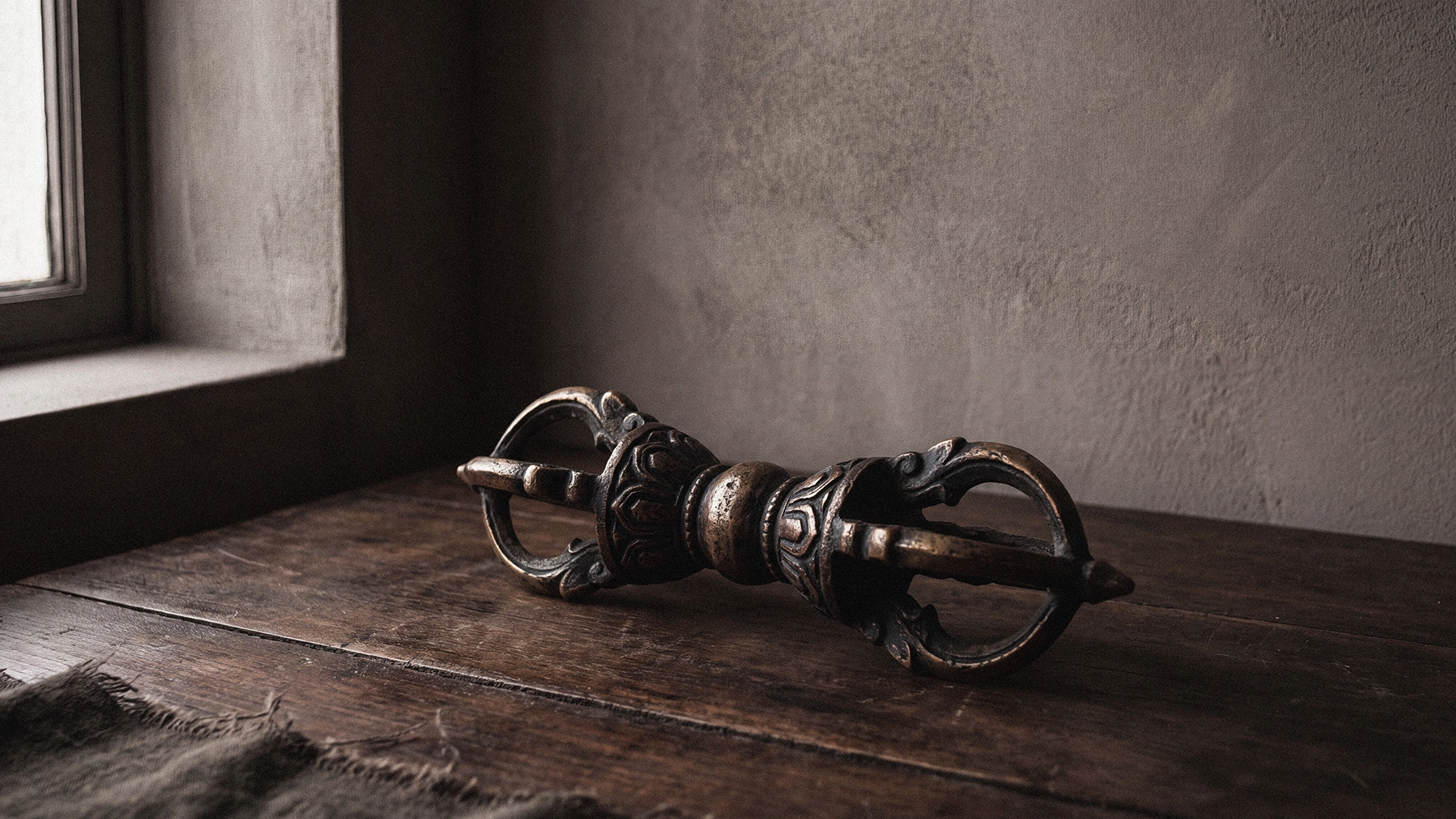
The search results can be confusing. 'Vajra Sutra,' 'Vajra Cutter Sutra,' 'Diamond Sutra,' and 'Dorje Chang Buddha' often appear side by side, yet they belong to different parts of the Buddhist world: a Mahayana scripture, a Sanskrit term, a Tibetan rendering of that term, and a figure in Tibetan Buddhist tradition. This guide sorts out which is which in plain language, with respect for Mahayana and Tibetan Buddhist contexts. At Kailash to Shambhala, we approach these names as cultural and symbolic depth rather than as doctrine to debate. Understanding the distinctions helps readers appreciate why a single word—vajra, or dorje—can travel across texts, ritual objects, and figures without meaning exactly the same thing each time.
What Is the Vajra Sutra?
The Vajra Sutra is a Mahayana Buddhist sutra in the Prajñāpāramitā, or 'perfection of wisdom,' family. It is best known in English as the Diamond Sutra and is also called the Vajra Cutter Sutra. The text takes the form of a dialogue between the Buddha and the disciple Subhuti. Its central theme is often described as cutting through rigid concepts, attachments, and fixed views—hence the image of a diamond that cuts while remaining unbroken. That phrasing is attributed to the sutra's traditional interpretation rather than a single official gloss. The Vajra Sutra has been especially important in East Asian Buddhist traditions, including Chan and Zen, and it circulated widely through Chinese translations. Its concise, penetrating style has made it one of the most studied Prajñāpāramitā texts.
Vajra Sutra, Vajra Cutter Sutra, and Diamond Sutra: The Names Explained
Vajra Sutra, Vajra Cutter Sutra, and Diamond Sutra refer to the same Mahayana sutra. The differences are linguistic and translational, not separate texts. The Sanskrit title includes vajra and a term meaning 'cutting' or 'cutter,' which gives English the renderings 'Vajra Cutter' and 'Diamond.' 'Diamond' emphasizes indestructibility; 'cutter' emphasizes that which cuts through. Translations vary in which emphasis they foreground, and neither is exclusive.
| Name | Language / Tradition | Note |
|---|---|---|
| Vajra Sutra | English / general | A short English name for the same Prajñāpāramitā sutra. |
| Vajra Cutter Sutra | English | Highlights the 'cutter' element of the Sanskrit title. |
| Diamond Sutra | English | The most common English title; 'diamond' suggests indestructibility. |
| Vajracchedikā Prajñāpāramitā Sūtra | Sanskrit | The fuller Sanskrit title of the text. |
From Sanskrit Title to Chinese and English Translation
The sutra circulated widely through Chinese translation traditions, which helped carry it across East Asia. Among the most influential is Kumarajiva's early fifth-century Chinese translation, which remains widely read. A printed copy of the Diamond Sutra found at Dunhuang, dated 868 CE, is often cited as an early surviving dated printed book. That detail belongs to cultural and printing history; it is not a doctrinal claim about the sutra's authority. English translations today draw on Sanskrit, Chinese, and Tibetan witnesses, and they differ in style and emphasis.
Vajra and Dorje: What the Words Mean
Vajra is a Sanskrit term; dorje is its Tibetan counterpart. A basic vajra definition is 'diamond' or 'thunderbolt,' though those English words do not exhaust the term's range. In Buddhist texts, the vajra meaning often centers on indestructibility, adamantine clarity, and the power to cut through confusion. Dorje carries the same core sense in Tibetan. In Tibetan Buddhist practice, dorje also names a ritual object—the double-ended implement held in the hand and often paired with a bell, or drilbu. The textual concept and the ritual object are related, but they are not identical.
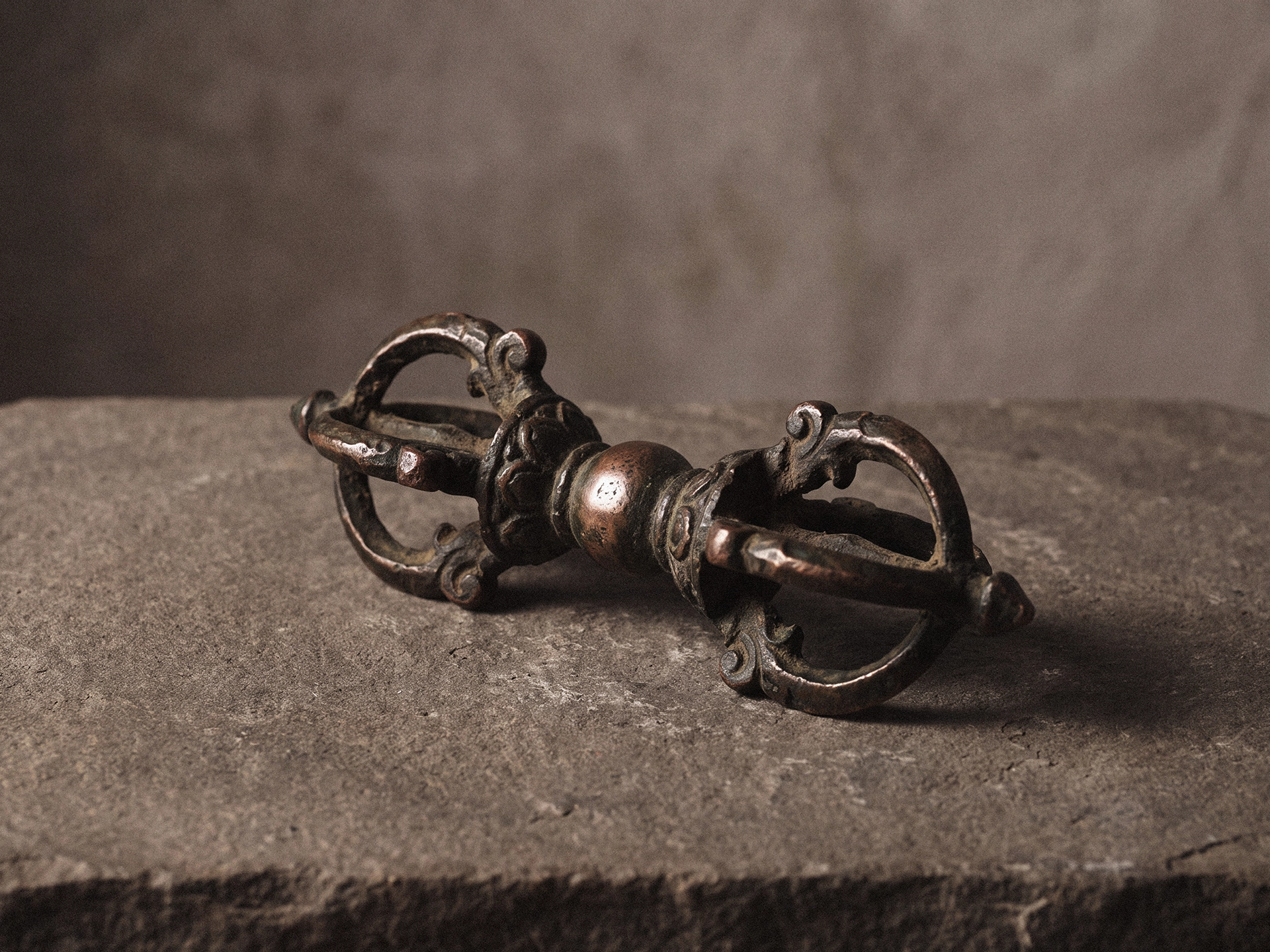
Another source of confusion is that vajra and dorje appear in many compound names: texts, objects, and figures. A vajra dorje pendant, for example, takes its form from the ritual object, while the Vajra Sutra takes its name from the textual term. As a Tibetan Buddhist symbol, the vajra is recognizable by its central grip and symmetrical prongs. Seeing the same word in different contexts does not mean the referents are the same. When readers ask what vajra dorje means, the answer often depends on whether the question is about the Sanskrit-Tibetan term, the ritual implement, or a name that contains it.
Who Is Dorje Chang (Vajradhara)?
Dorje Chang is the Tibetan name for Vajradhara, a figure in Tibetan Buddhism associated with the tantras. In Tibetan Buddhist tradition, Vajradhara is often described as a primordial or ultimate buddha and as a source of tantric transmission in several lineages. These descriptions are attributed to the tradition; different schools and teachers may phrase them differently.
Visually, Vajradhara is commonly depicted holding a vajra and a bell, with the arms crossed at the chest. This is iconography—a recognizable convention—rather than a doctrinal proof. It is also distinct from the historical Shakyamuni Buddha, who is traditionally regarded as the Buddha of the present era. Dorje Chang is not simply another name for Shakyamuni; the two figures belong to different explanatory frameworks within Buddhist tradition.
Dorje Chang Buddha and Shakyamuni Buddha: How the Relationship Is Understood
Within Tibetan Buddhist understanding, Dorje Chang Buddha and Shakyamuni Buddha are related but not simply identical. Shakyamuni is regarded as the historical Buddha of the present era. Vajradhara is understood in some traditions as an ultimate or transcendent expression of buddhahood rather than a historical human teacher. Different schools and commentators describe the relationship differently. Some emphasize continuity, others emphasize distinct roles in tantric transmission. This article does not rank one above the other; it simply notes that the terms answer different questions. Shakyamuni points to a historical teacher and the founding of the present Buddhist dispensation. Vajradhara points to the tantric lineage and the transmission of esoteric teachings in Tibetan Buddhist contexts.
The Vajra Rosary Tantra and the Wider Tantric Context
The Vajra Rosary Tantra is a tantric text, and it belongs to a different category from the Vajra Sutra. In general terms, a sutra is a discourse attributed to the Buddha and is often presented as a teaching intended for a broad audience. A tantra is an esoteric text that may include ritual, mantra, visualization, and lineage transmission. The two categories are not interchangeable, and detailed tantric doctrine should be studied with a qualified teacher rather than reduced to a summary.
In Tibetan traditions, the Vajra Rosary Tantra is often classified within the wider tantric corpus and associated with the Guhyasamāja cycle. That classification is traditional and commentarial; this article does not attempt to explain its practices. The important point for terminology is simple: the word vajra appears in many titles as a naming pattern. It does not mean that the Vajra Sutra, the Vajra Rosary Tantra, and every other vajra text are the same kind of work.
'Dorje Chang Buddha Sutra' and 'Dorje Chang Buddha Dharma': Clarifying the Terminology
The phrases 'Dorje Chang Buddha Sutra' and 'Dorje Chang Buddha Dharma' reflect a mix of classical and contemporary usage. Readers should not assume they point to a single specific text. In the classical Tibetan context, Dorje Chang refers to Vajradhara and is linked to tantric literature rather than to a specific sutra of that name. The term 'Dorje Chang Buddha' also appears in newer and contemporary Buddhist contexts. This article focuses on the traditional Buddhist background rather than on any single modern movement.
When encountering these phrases, it helps to check the source, the author, and the tradition behind the usage. Terminology can be used devotionally, historically, or institutionally, and those contexts are not always the same. A respectful reading does not require accepting every claim at face value, nor does it require dismissing a tradition outright. It simply asks what a term means in the setting where it appears.
From Sutra to Symbol: Why This Context Matters in Modern Ritual Life
The vajra or dorje bridges text and object. It is a concept in sutras and tantras, and it is also a tangible ritual form. In a modern setting, this symbolism can suggest steadiness, clarity, and the ability to cut through noise and confusion. For Kailash to Shambhala, that interpretation is an additive layer. It sits alongside traditional meaning rather than replacing it. We are drawn to forms that hold a clear silhouette and a quiet material presence—objects that do not need to shout to be noticed.
A vajra- or dorje-inspired object might rest on a personal altar, a desk, a shelf, or be carried as a wearable form such as a dorje pendant. Its value in that setting is the way a well-made object can become a point of return: a physical reminder to pause, to steady the mind, and to meet the day with a little more clarity. That is the quiet bridge from sutra to symbol—text, object, and daily life held in the same frame.
Frequently Asked Questions
Is Dorje Chang (Vajradhara) the same as Vajrapani?
No. Vajrapani and Vajradhara are distinct figures who share the 'vajra' element in their names. Vajrapani is traditionally associated with protection and is often depicted in Bodhisattva or protector forms. Vajradhara is associated with tantric transmission and is described in Tibetan Buddhist tradition as a primordial or ultimate buddha. The shared word does not make them the same figure.
Is Dorje Chang Buddha a historical person like Shakyamuni Buddha?
In Tibetan Buddhist understanding, Vajradhara is generally described as a primordial or transcendent figure rather than a historical human teacher in the way Shakyamuni is. Shakyamuni is regarded as the historical Buddha of the present era. Interpretations differ across traditions, and some teachers emphasize different aspects of the relationship.
What does 'vajra' mean in English?
Vajra is commonly rendered as 'diamond' or 'thunderbolt.' In Buddhist contexts, it can suggest indestructibility, clarity, and the capacity to cut through confusion. Dorje is the Tibetan counterpart of the same term.
Is the Vajra Sutra the same as the Vajra Rosary Tantra?
No. The Vajra Sutra is a Mahayana Prajñāpāramitā sutra. The Vajra Rosary Tantra is a tantric text. They belong to different categories of Buddhist literature, even though both include the word vajra in their titles.
Conclusion
The Vajra Sutra, the Vajra Cutter Sutra, and the Diamond Sutra name one Mahayana sutra. Dorje Chang names the figure Vajradhara. The terms are related through the word vajra, but they point to different things: a scripture, a Sanskrit-Tibetan term, a ritual object, and a tantric figure. That range is exactly why context matters. When readers understand which is which, they can approach the symbolism with more accuracy—and, for those who keep a small altar, a desk, or a quiet corner, draw on the vajra's image of clarity and steadiness without confusing a symbol with a doctrine. Kailash to Shambhala holds that clarity as part of the quieter side of ritual life: material, contemplative, and grounded in respect for the tradition behind the form.