


Introduction: What Is the Dorje, and Why Does It Matter as a Tattoo?
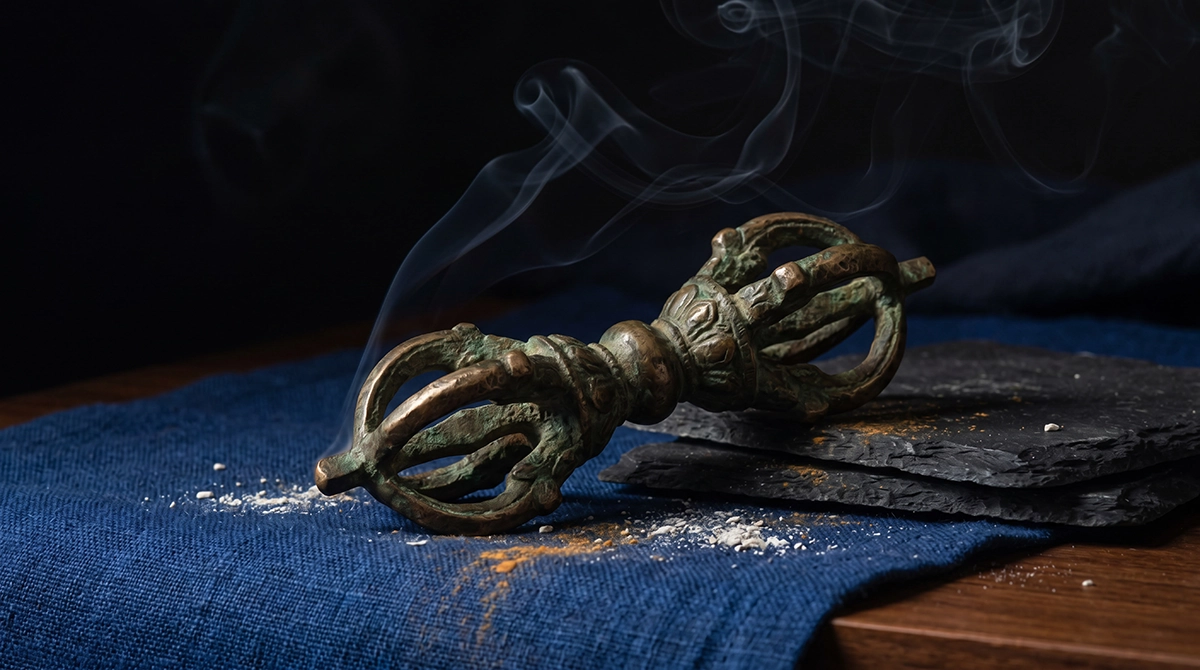
The Dorje, also called the Vajra, is the primary ritual implement of Tibetan Buddhism, symbolizing the indestructible, diamond-like nature of awakened mind and the thunderbolt clarity that cuts through ignorance, fear, and inner confusion. This is the heart of vajra tattoo meaning: not decoration alone, but a visible commitment to unshakable wisdom.
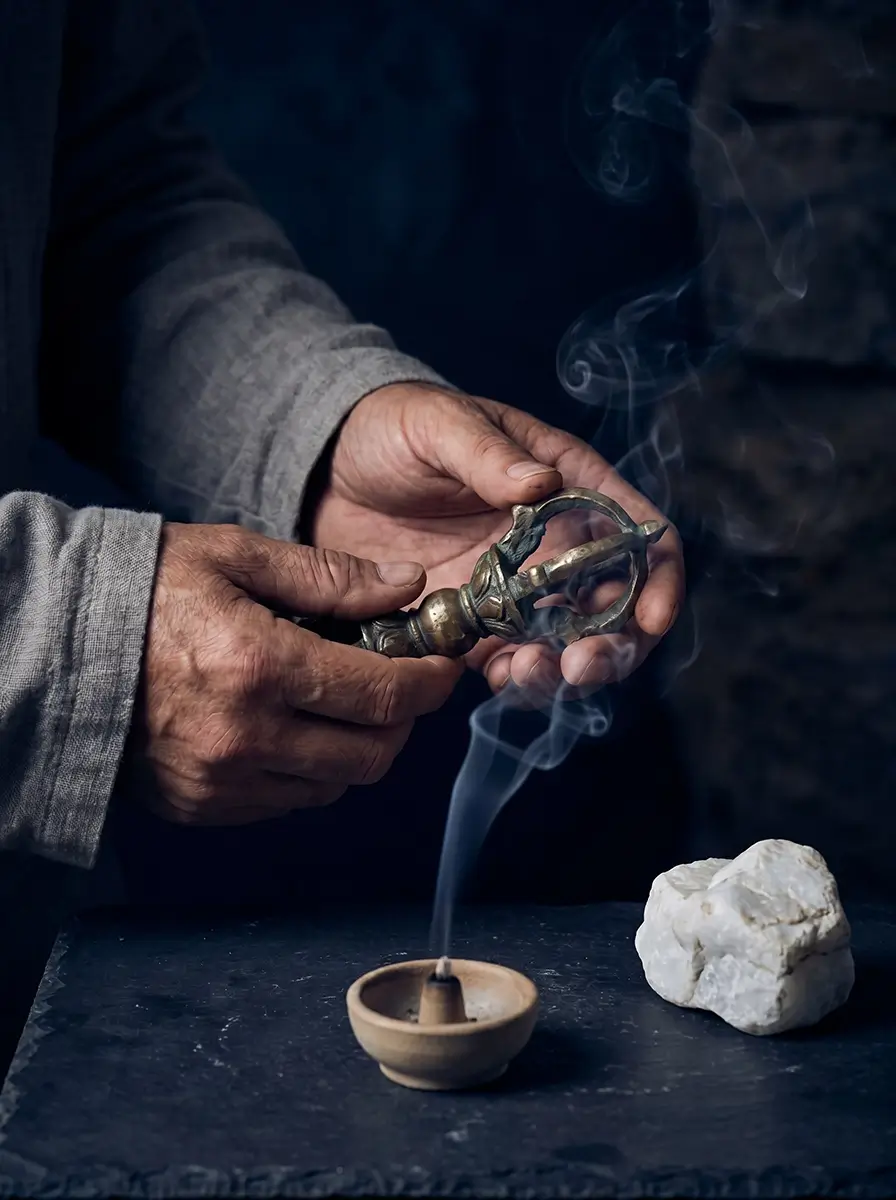
When seekers ask me what does the dorje symbol mean, I begin with its presence in the hand. In Tibetan Buddhist ritual, the Dorje is held with precision and reverence. It is often paired with the bell, forming a sacred dialogue between method and wisdom, compassion and emptiness, action and insight. The Dorje is small enough to rest in the palm, yet symbolically vast enough to represent the mind that cannot be broken.
A Dorje tattoo carries this same paradox. It is intimate, inked into the living body, yet it points toward something beyond the body: the stable awareness beneath anxiety, identity, and passing emotion. For modern practitioners, spiritual collectors, and those drawn to tattoos of wisdom, the Dorje becomes a mark of remembrance.
Curator's Note
"It asks quietly: when life strikes like thunder, can your center remain clear like diamond?"
"The true sacred object does not perform the path for us. It reminds us to return to it."
What Is the Spiritual Meaning of a Dorje Tattoo: Protection, Enlightenment, and Inner Strength?
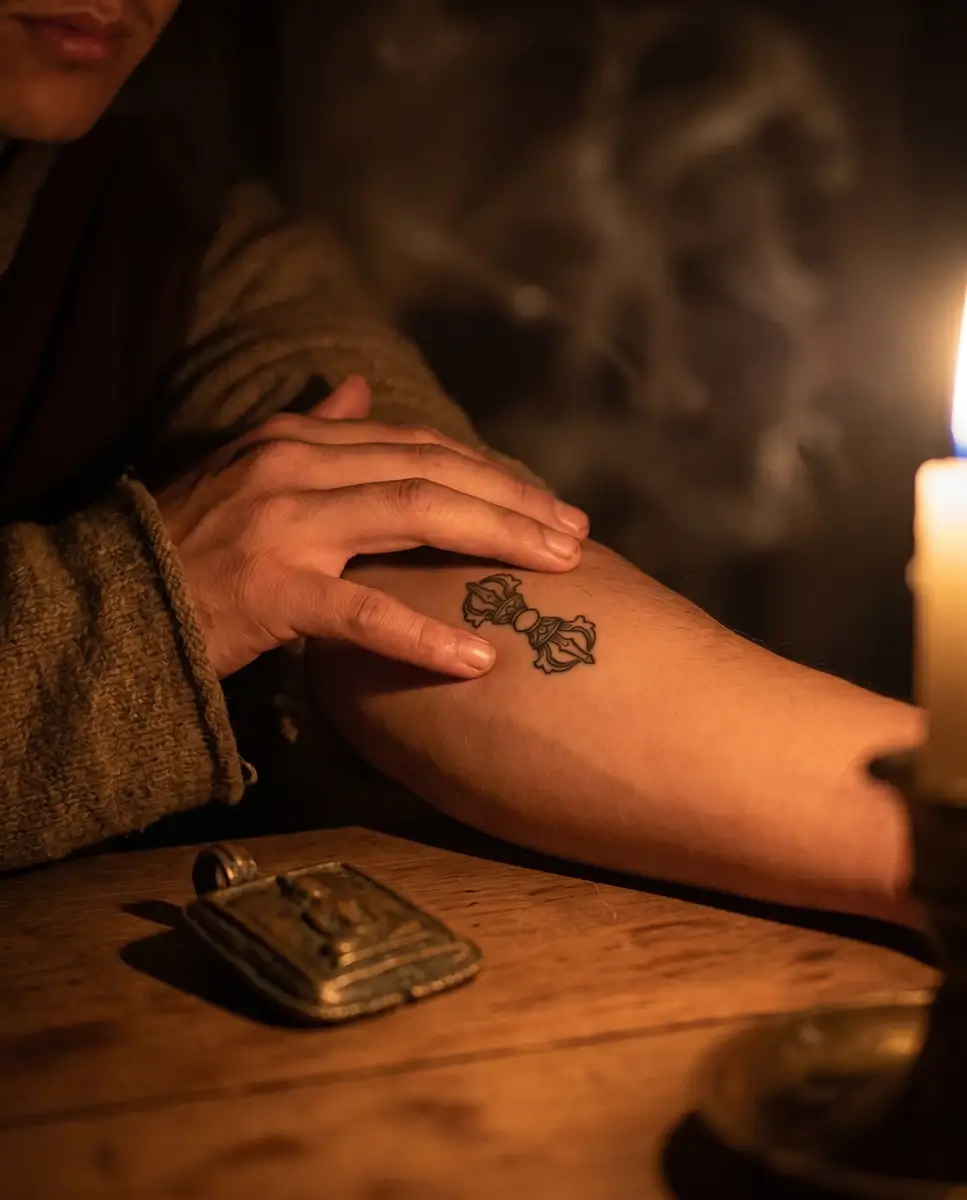
A Dorje tattoo represents spiritual protection, awakened wisdom, and inner strength by placing the symbolism of the Vajra directly on the body as a meditative anchor rather than as magical armor or a promise of worldly luck. This is why dorje tattoo meaning remains powerful for serious practitioners.
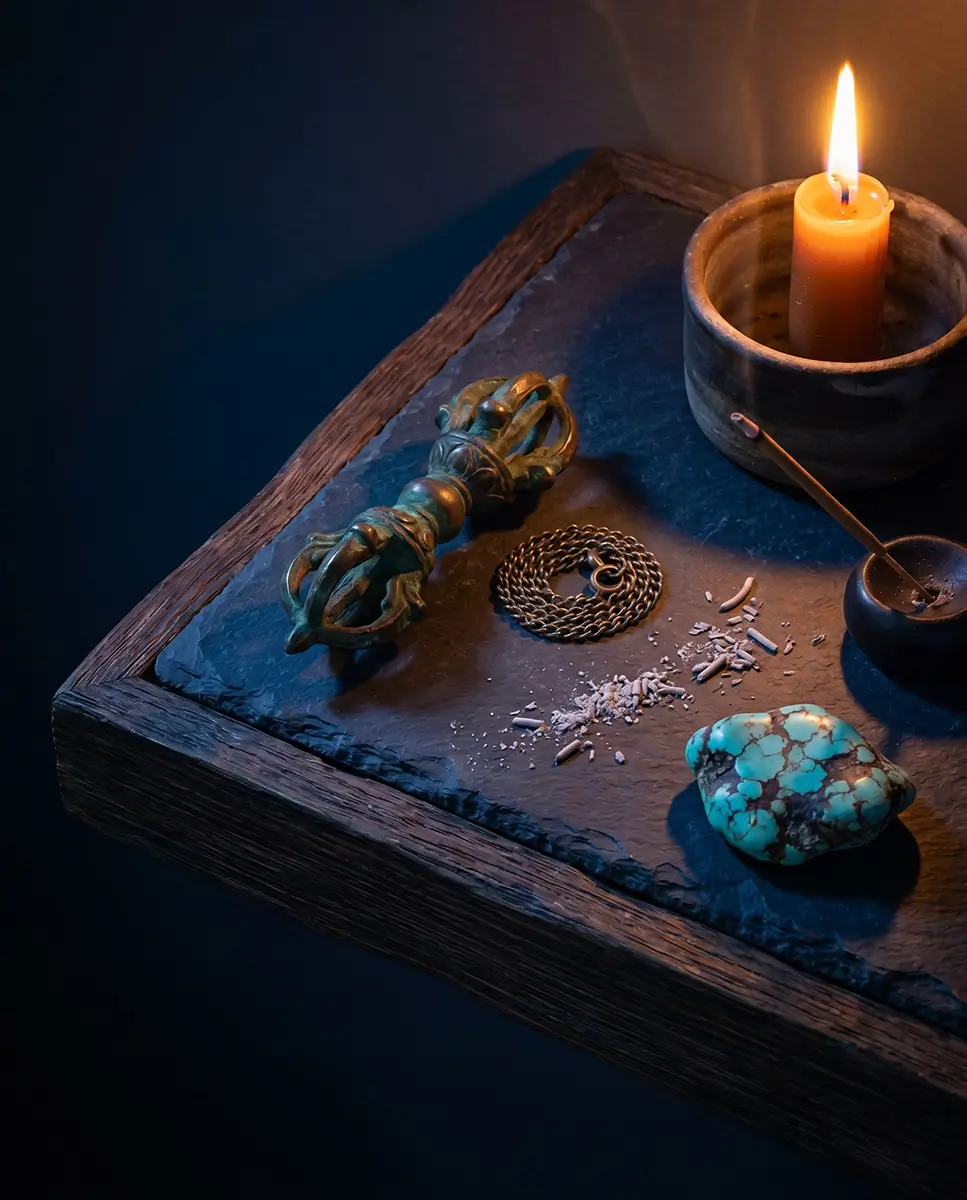
A vajra symbol tattoo is often chosen by those who want their body to carry a sacred reminder. The skin becomes a threshold: outer image, inner vow. In my view, the best tattoos about wisdom do not shout. They remain steady, like a bronze ritual tool resting on a cloth darkened by incense smoke.
The Dorje works through three primary spiritual intents:
The Dorje as a Tool of Indestructible Protection: PROTECT
The Dorje’s sharp, balanced, five-pronged form symbolizes the shattering of ignorance and the guarding of spiritual integrity. In Tibetan Buddhist symbolism, protection is not aggression. It is clarity that refuses to be pulled into chaos.
A Dorje tattoo can be understood as a protected necklace made permanent in the body’s own language. Like a spiritual necklace protection piece worn close to the chest, it reminds the wearer to protect attention, speech, and energy. It is especially meaningful for those who feel porous in crowded spaces or emotionally turbulent seasons.
This protection is not superstition. It is practice. When the wearer sees the symbol, touches the skin, or remembers the placement, the nervous system receives a cue: return to center.
Enlightenment and the Awakening of Diamond Wisdom: AWAKEN
The Sanskrit word Vajra means both thunderbolt and diamond. The thunderbolt suggests sudden illumination. The diamond suggests indestructible clarity. Together, they describe wisdom that is direct, embodied, and impossible to reduce to ordinary knowledge.
This is where tattoos for wisdom become more than aesthetic choices. The Dorje does not simply mean intelligence. It points toward awakened perception: seeing through illusion without becoming cold, detached, or arrogant.
A vajra tattoo design can therefore act as a visual koan. Its geometry asks the wearer to contemplate stability and emptiness, force and compassion, form and spaciousness. Each line becomes a question carried under the skin.
Inner Strength and Purification: PURIFY
In ritual use, the Dorje is often paired with the bell, also known as the Ghanta. The Dorje and bell together represent the union of skillful method and wisdom. One without the other is incomplete.
For a tattoo, this union can symbolize purification: the clearing of obscurations, reactive habits, and old emotional residue. The Dorje does not erase pain. It gives the practitioner a form through which to meet pain with steadiness.
Some seekers pair the Dorje with lotus petals, flame motifs, or a subtle bell shape to honor this ritual relationship. Others keep the symbol alone, trusting its severe beauty: aged bronze in the mind, black ink on the body, a silent instrument of return.
What Dorje Tattoo Designs and Vajra Tattoo Ideas Carry the Strongest Visual Meaning?
Dorje tattoo designs range from minimalist blackwork to intricate Tibetan-inspired ritual compositions, with each style changing how the symbol speaks through the body: quiet reminder, protective seal, mandala foundation, or sacred necklace-like ornament. The best vajra tattoo ideas begin with intent before aesthetics.
The Dorje is visually adaptable. It can appear as a single horizontal ritual object, a double dorje vajra cross, a pendant-like chest piece, or a larger Tibetan-inspired pattern integrated into the shoulders, sternum, spine, or clavicle.
For Pinterest-oriented inspiration, I think in textures: black ink like soot, fine lines like hammered silver, stippling like shadow on temple stone, and negative space like breath between mantra syllables.
The Single Dorje: Classic and Minimal
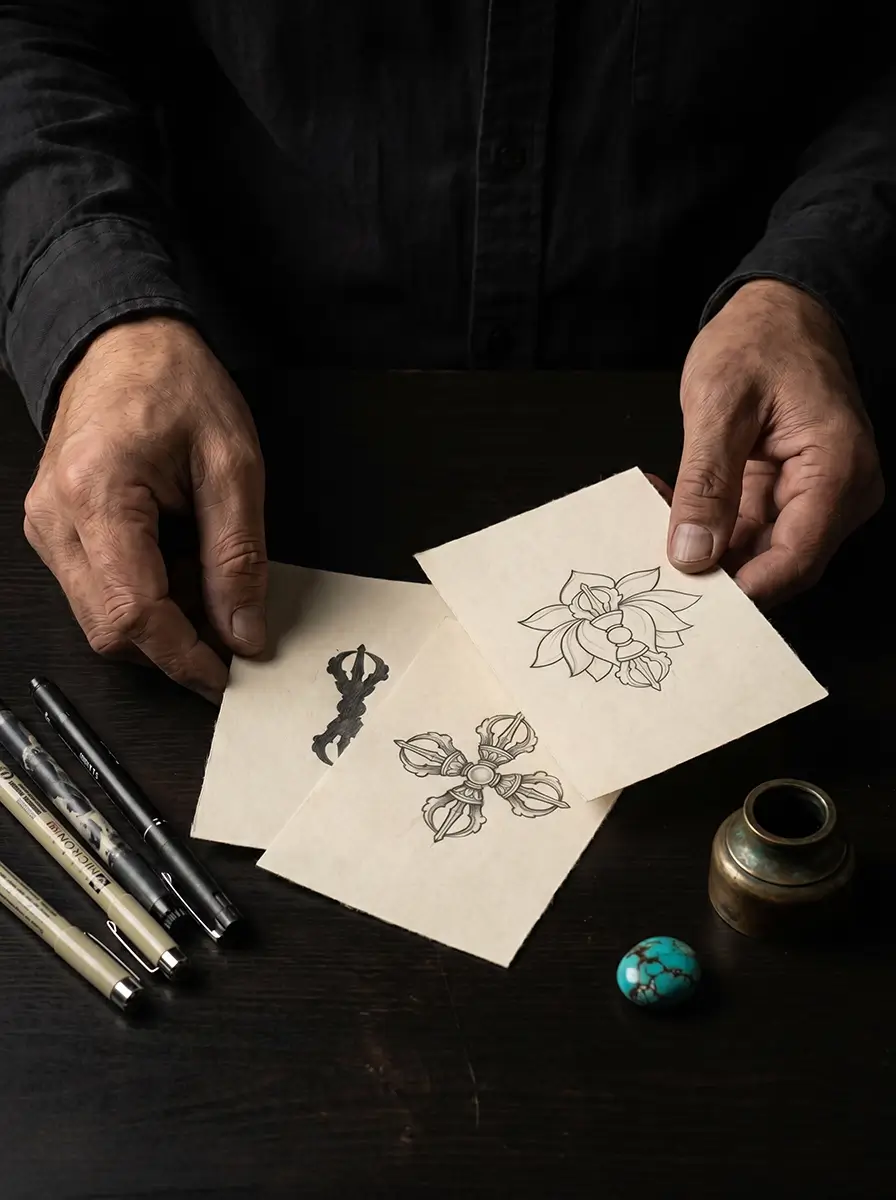
A single Dorje tattoo is ideal for those who want clean structure and quiet symbolism. It works well on the inner wrist, forearm, ankle, sternum, or behind the ear.
The minimalist version usually emphasizes:
- Thin black lines
- Symmetrical prongs
- A central sphere or lotus-like hub
- Small-scale placement
- A restrained, contemplative feeling
This style suits the seeker who wants a personal reminder rather than an obvious proclamation. It is the tattoo equivalent of a small vajra pendant resting beneath a linen collar.
The Double Dorje: Vishvavajra
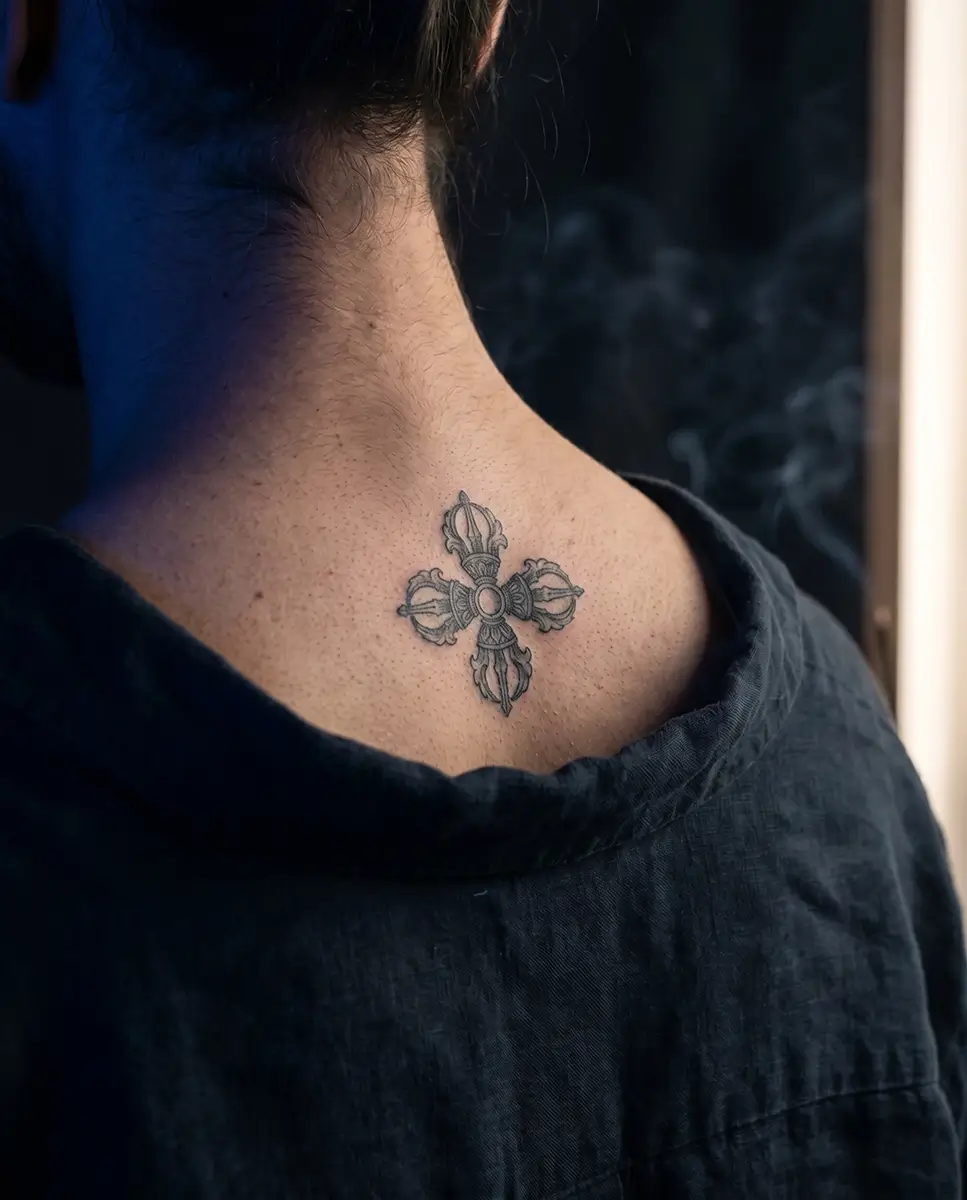
A double dorje tattoo, also known as the Vishvavajra, forms a crossed Vajra shape. It is often associated with stability, mandala structure, and the unshakable foundation of awakened reality.
Visually, the double Dorje has more architectural power than the single form. It can feel like a seal, a compass, or a sacred diagram. For this reason, I often see it working beautifully on larger areas:
- Upper back
- Center of the chest
- Between the shoulder blades
- Over the heart
- Along the spine
A double dorje tattoo is especially strong when rendered with heavy stippling, temple-metal shading, or geometric precision. It should feel balanced, never rushed. The symbol depends on symmetry, and symmetry depends on a careful artist.
The Tibetan Dorje: Detailed and Ritualistic
A Tibetan dorje tattoo usually includes more ornamental detail: lotus petals, layered prongs, central beads, flame-like curves, and a ritual-object silhouette. This style honors the Dorje as an implement, not only as a graphic symbol.
The best Tibetan-inspired designs feel carved rather than printed. They carry the mood of a Tibetan pendant necklace, an old altar object, or a ritual tool handled for years until the metal softens beneath the thumb.
A detailed vajra symbol tattoo may include:
- Lotus bases at each end
- Five-pronged Dorje structure
- Fine-line shading
- A central sphere representing unity
- Tibetan-style geometry without claiming false origin
Because cultural respect matters, I recommend studying the form before wearing it. Ask what does the dorje symbolize in its own tradition, not only how it looks on skin.
Tribal Necklace Tattoo: Integrating the Dorje with the Body
A tribal necklace tattoo can frame the Dorje as a protective garland around the clavicle, throat, or upper chest. This style turns the body into a living amulet necklace, with the Dorje resting near the heart or solar plexus.
Tribal necklace tattoos are visually powerful because they move with the anatomy. They can follow the collarbones, wrap the shoulders, or descend like a pendant from the throat center. When done respectfully, tribal necklace tattoo designs can create the feeling of spiritual jewelry made from ink.
I would frame the Dorje at the center rather than bury it in ornament. Let the symbol breathe. Let the surrounding pattern act like beads, cord, or shadow.
Callout: The weight of a physical Dorje pendant resting on your chest can serve as the same anchor—before and after the needle touches skin. A tibetan silver pendant, bronze vajra pendant, or Tibetan-style necklace can help you live with the symbol before making it permanent.
Where Should You Place a Meaningful Dorje Tattoo on the Body?
A meaningful Dorje tattoo placement should match the wearer’s spiritual intent: the forearm for active protection, the heart center for private devotion, and the spine or back of neck for stability and inner alignment. Placement shapes how the symbol is seen, felt, and remembered.
When considering vajra tattoo ideas, I always ask: do you want the Dorje to face the world, guard the heart, or stabilize the central axis of the body? The answer changes the design.
Placement |
Spiritual Intent |
Visual Feeling |
Best Design Style |
|---|---|---|---|
Forearm |
Active protection and mindful action | Visible, direct, intentional | Single Dorje or fine-line Vajra |
Chest / Heart |
Compassion and inner commitment | Private, devotional, intimate | Dorje with lotus or pendant-like form |
Spine / Back of Neck |
Stability and central alignment | Architectural, grounded, powerful | Double Dorje or vertical composition |
Behind Ear |
Subtle wisdom and inner listening | Quiet, personal, minimal | Tiny line-art Dorje |
Clavicle |
Protective garland and ritual adornment | Ornamental, necklace-like | Tribal necklace tattoo with central Dorje |
Forearm: Active Protection
The forearm moves through the world. It reaches, writes, works, offers, refuses, and receives. A Dorje placed here becomes a reminder to act with discernment.
For those drawn to protective jewelry, protection necklaces, or a protection necklace worn daily, the forearm tattoo offers a similar function in visible form. It does not promise to control outer events. It asks the wearer to meet them with clarity.
Chest and Heart Center: Inner Anchor
Over the heart, the Dorje becomes private and devotional. This placement is less about display and more about relationship: the relationship between strength and compassion, precision and tenderness.
A Dorje over the heart can be paired with lotus petals or kept simple. It may resonate with those who wear a tibetan bead necklace, chakra stone necklace, throat chakra necklace, or other spiritual jewelry as daily reminders of inner practice.
Here, the Dorje is not only PROTECT. It also CONNECTS. It guards the heart without closing it.
Spine and Back of Neck: Foundation
The spine suggests the central channel, the upright axis of meditation, and the dignity of posture. A double Dorje on the upper back or nape can feel like a mandala foundation placed on the body’s architecture.
This is one of the strongest placements for a double dorje tattoo because the cross-like stability of the Vishvavajra mirrors the body’s own vertical support. It is quiet when clothed, powerful when revealed.
For some, this placement becomes a reminder to stand in one’s practice, especially during seasons of uncertainty.
A Simple Placement & Understanding Ritual Before Committing
Before choosing placement, I suggest a short contemplative process. But contemplation must be paired with understanding. You are not just inking a beautiful geometric shape; you are mapping an ancient spiritual technology onto your body.
- Sit quietly with an image of the Dorje for three minutes.
- Place your hand on the body area you are considering.
- Ask whether the symbol feels protective, awakening, purifying, or grounding there.
- Study the anatomy of the symbol. Know why it has five prongs instead of nine, and what the central lotus base represents before your artist draws the stencil.
- Wear a vajra pendant or Tibetan-inspired amulet necklace in that area for several days if possible.
- Notice whether the symbol feels like a trend, a vow, or a true companion.
Insight: True reverence begins with knowledge. Understanding the exact architecture of the Vajra ensures your tattoo is a vessel of authentic wisdom, not just an empty aesthetic copy.
How Can a Physical Dorje Pendant Anchor the Meaning of Your Ink?
A physical Dorje pendant can serve as the touchable companion to a Dorje tattoo, allowing the wearer to feel the symbol’s weight, texture, and presence as part of daily meditation rather than leaving the meaning only in visual form. The tattoo is the vow; the pendant is the tool.
There is a difference between seeing a symbol and touching it. Ink lives with the skin. Metal speaks through weight. A bronze or Tibetan silver pendant rests against the chest, warms with the body, and returns the attention each time the fingers find it.
This is why I often recommend living with a vajra pendant before receiving a permanent Dorje tattoo. Not as a test of worthiness, but as a practice of intimacy. Does the form still speak after a week? After a month? Does it calm the breath when held during difficulty?

The Weight of Wisdom: From Ink to Touch
The tattoo is the map. The pendant is the compass. Together, they form a complete circle of intent.
A Dorje tattoo marks a threshold moment: a decision, a grief survived, a practice begun, a vow renewed. A physical pendant continues the conversation after the needle is gone. Its surface can be rubbed during meditation. Its weight can be felt during travel. Its presence can transform an ordinary morning into a small ritual.
In the Kailash to Shambhala journey, I see the Dorje as both artifact and witness. A tibetan pendant, gold vajra pendant, or tibetan style necklace should not be treated as costume. It is a vessel for attention.
For those who already wear a chunky boho necklace, tribal stone necklace, chakras necklace, or 7 chakra necklace, the Dorje offers a more specifically Vajrayana Buddhist symbolic language. Its meaning is sharper, more diamond-like. It does not merely decorate the aura of spirituality. It calls the mind to precision.
Tattoo and Pendant: Two Ways to Carry the Dorje
Pathway |
What It Offers |
Best For |
Spiritual Reminder |
|---|---|---|---|
Dorje Tattoo |
Permanent visual vow | Long-term commitment to the symbol | I carry wisdom in my body |
Dorje Pendant |
Touchable daily anchor | Meditation, travel, tactile grounding | I return to wisdom through touch |
Dorje and Bell Practice |
Ritual symbolism of method and wisdom | Practitioners studying Tibetan Buddhism | Wisdom and compassion must remain united |
Tibetan-Inspired Necklace |
Wearable sacred adornment | Those not ready for ink | I can live with the symbol first |
A tattoo marks the skin once. A pendant asks to be chosen each morning. Both can be sacred when approached with sincerity.
What Are the Key Takeaways About Vajra Tattoo Meaning?
The core vajra tattoo meaning is the embodiment of indestructible wisdom, spiritual protection, purification, and awakened inner strength through the sacred Buddhist symbol of the Dorje. When someone asks what does the dorje symbolize, the answer is both simple and profound: unbreakable clarity.
- Spiritual Core: The Dorje embodies the indestructible diamond wisdom of enlightenment and the thunderbolt force that cuts through ignorance.
- Design Range: Dorje tattoo designs can move from minimalist single Dorje forms to intricate double Dorje, Tibetan dorje tattoo compositions, and necklace-like tribal designs.
- Dual Anchor: A tattoo marks the commitment; a Dorje pendant in bronze, silver, or another meaningful metal becomes the daily, touchable companion.
- No Magic, Only Meaning: The Dorje is a meditation tool and personal anchor, not a tool for gambling, control, or shallow luck-seeking.
- Placement Matters: Forearm, heart, spine, neck, and clavicle each change the way the symbol supports protection, awakening, connection, and stability.
- Respect the Lineage: A Vajra symbol tattoo should be approached with cultural humility, visual study, and genuine reverence for Tibetan Buddhist meaning.
To carry the Dorje is to carry a question: can wisdom remain steady when the world becomes loud?
Whether chosen as ink, pendant, amulet necklace, or altar object, the Dorje belongs to the path of AWAKENING. It is not a promise that life will soften. It is a reminder that the mind can become clear enough to meet life without breaking.
May your chosen symbol be more than an image. May it become an anchor of protection, a vessel of purification, and a quiet witness to the Inner Shambhala already forming within you.